
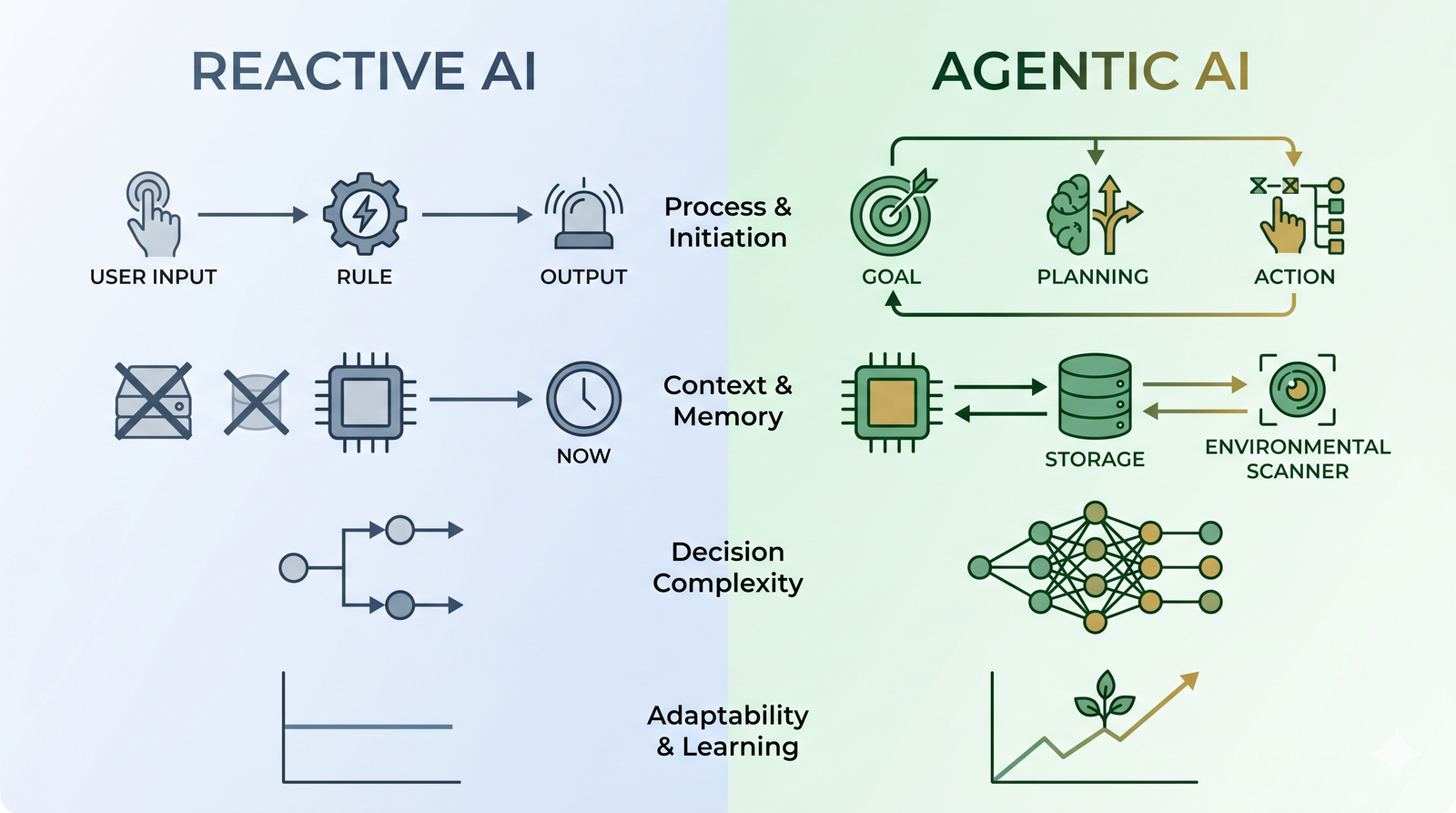
The operational difference between Reactive AI and Agentic AI comes down to autonomy and goal execution. Reactive AI responds to a specific trigger with a single output and stops, requiring continuous human prompts to move work forward. Agentic AI, conversely, receives a high-level objective, creates a plan, uses external tools to execute steps, and iterates based on feedback until the goal is completed independently.
The Anatomy of Reactive AI
To understand the shift toward autonomous systems, we first need to look at how traditional generative models function in an enterprise setting. Reactive AI operates as a stateless input-output mechanism. You provide a prompt, the system processes it based on its training data, it generates a response, and then its job is entirely finished.
At a technical level, these systems are highly sophisticated text predictors. They do not possess inherent memory of previous interactions unless that history is manually fed back into the current prompt via the context window. They also lack initiative. A reactive system will never wake up on its own and decide to run a database query because it noticed a discrepancy in your inventory. It relies entirely on a human trigger.
In daily business operations, reactive AI serves as a powerful digital assistant. It is excellent for isolated, well-defined tasks such as drafting marketing copy, summarizing legal documents, or writing blocks of code. However, it introduces significant operational bottlenecks at scale. Because it only executes a single step at a time, human workers must act as the orchestrators. The human must copy the data, write the prompt, review the output, and then paste that output into the next software application to actually complete a business workflow.
The Architecture of Agentic AI
Agentic AI fundamentally changes this dynamic by shifting the operational model from prompt engineering to goal orientation. Instead of acting as an isolated intelligence, an agentic system functions as a continuous, self-correcting feedback loop.
This requires a completely different architectural approach. In an agentic setup, the large language model acts strictly as a reasoning engine. It is connected to several other crucial components to give it agency. First, it has access to memory, usually facilitated by vector databases and retrieval-augmented generation (RAG), allowing it to recall past actions, user preferences, and internal company documents.
Second, and most importantly, agentic AI is granted tool access. Through robust APIs and function calling, the AI can interact directly with your existing software stack. It can read a customer record in your CRM, execute a Python script in your terminal, or send a notification in Slack.
This combination of reasoning, memory, and tool usage transforms the AI from a digital assistant into a digital worker. The market is recognizing this shift rapidly. According to a recent report by Precedence Research, the global agentic AI market is projected to reach nearly $199 billion by 2034, growing at a compound annual growth rate of nearly 44%. This massive financial investment is driven entirely by the promise of operational autonomy and reducing the human overhead required to run software.
Single-Agent vs. Multi-Agent Systems
When deploying these systems, businesses generally choose between single-agent and multi-agent frameworks. In a single-agent system, one core reasoning engine manages all tools and planning. According to data from Grand View Research, single-agent systems currently dominate the market revenue because they are easier and faster to implement in existing corporate environments.
In a multi-agent system, several specialized agents collaborate to achieve the goal. One agent might be responsible solely for data extraction from unstructured PDFs, while another specializes in writing code to process that data, and a third acts as a manager to audit the work before execution. This modular approach is more complex to build but highly effective for robust, enterprise-scale operations.
How Agentic AI Executes a Workflow
When you deploy an agentic system, the execution logic is circular rather than linear. Here is the step-by-step logic of how these systems operate in production frameworks like LangChain or LangGraph.
Step 1: Goal Input and Constraints. The system is given a broad directive rather than a micro-task. For instance, the instruction might be to audit the monthly marketing spend against the current budget. Alongside the goal, the system is given constraints, such as explicit rules to not modify any core database tables.
Step 2: Reasoning and Planning. The reasoning engine breaks the large goal down into a sequence of smaller, manageable tasks. It decides which internal tools it needs to use, what data it must retrieve, and in what order the operations should happen.
Step 3: Action and Execution. The agent begins executing its plan. It authenticates into the necessary platforms, runs the API calls to pull the marketing spend data from your ad platforms, and retrieves the budget documents from the company’s internal cloud storage.
Step 4: Evaluation and Correction. This is the stage where agentic AI proves its operational value. After taking an action, the agent evaluates the result. If a database query fails due to a formatting error, a reactive AI would simply stop and return an error message to the user. An agentic AI reads the error log, realizes its syntax was wrong, rewrites the SQL query independently, and tries again until it successfully extracts the data.
Reactive AI vs. Agentic AI Comparison
| Feature | Reactive AI | Agentic AI |
| Trigger Mechanism | Manual, human prompt | Autonomous, goal-driven |
| Operational Output | Single static response | Continuous workflow execution |
| Error Handling | Fails or hallucinates silently | Detects errors and self-corrects |
| Tool Integration | Limited to training context | Actively calls external APIs |
| Corporate Role | Digital assistant | Digital worker |
The Governance Challenge
Honesty requires acknowledging that agentic AI introduces complex security challenges. When you give software the ability to think and act independently, the risk profile of your organization changes.
If an agent is poorly configured, it can loop infinitely while trying to solve a problem, racking up massive API costs. More concerningly, if an agent is given write-access to a core database without proper guardrails, a flawed reasoning step could lead to unintended data deletion or erratic customer communications.
Successful enterprise deployment requires strict role-based access control. Agents should operate on the principle of least privilege, meaning they only have the exact permissions necessary to complete their specific tasks. Furthermore, human-in-the-loop workflows remain essential for high-stakes decisions. The agent should do the heavy lifting of gathering data and proposing a solution, but a human should authorize the final execution.
Actionable Next Steps
To begin transitioning your organization from reactive prompting to agentic automation, you must rethink your core workflows. Here are three concrete things you can do today to prepare:
- Map Your Repetitive Workflows. Identify processes that currently require a human to manually move data from one application to another. Tasks involving copying information, executing basic decision routing, and pasting the result are the highest-value targets for agentic automation.
- Audit Your Internal APIs. Agentic AI is only as capable as the software ecosystem it lives in. Ensure your core business applications, such as your CRM, billing software, and ERP, have robust and well-documented APIs that an AI agent can securely interact with.
- Define Clear Guardrails. Start with a low-risk internal process. Define explicit success criteria, set up strict operational boundaries, and test how an agent handles edge cases in a sandbox environment before giving it access to any production data.
Conclusion
The transition from reactive AI to agentic systems is a necessary evolution for businesses looking to scale their operations efficiently. While reactive models are great for providing fast information, agentic systems are built to actually do the work.
If you need custom help designing, building, or implementing secure agentic AI architectures tailored to your enterprise data, our AI and Data Science agency, Tensour can assist. Reach out to discuss your specific operational challenges.
Leave a Reply