
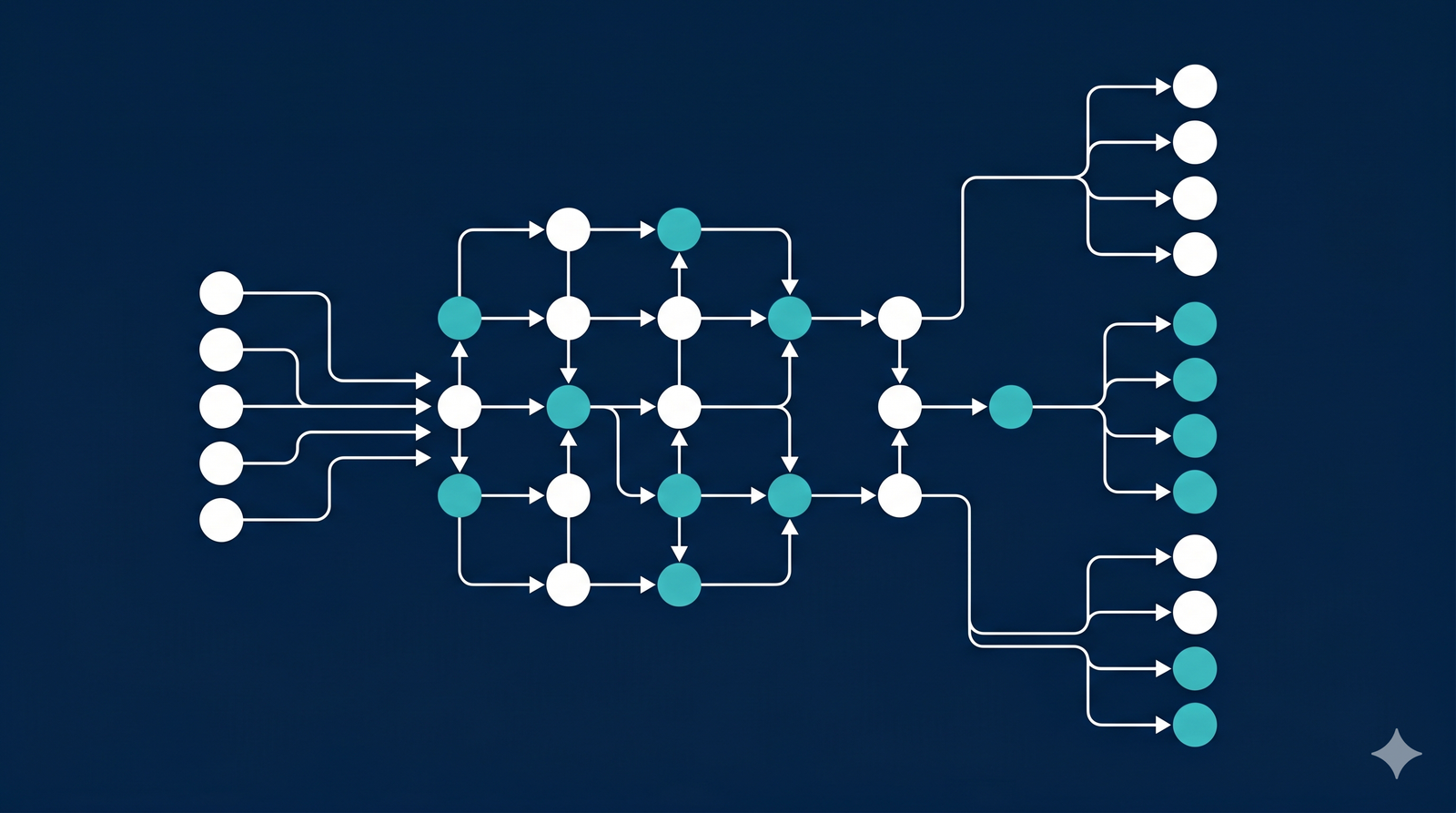
Deploying agentic AI for high-volume service requests requires integrating a large language model with your CRM and internal APIs to autonomously categorize, resolve, or route incoming tickets. By allowing AI agents to handle data retrieval and routine decisions, you free your human staff to manage complex escalations. This approach creates an intelligent triage system that drastically reduces resolution times without sacrificing the quality of your customer support.
Customer service at scale is an engineering problem. When incoming service requests spike, human teams become overwhelmed, leading to delayed response times and degraded service quality. Traditional automation methods, like rigid decision trees and keyword-based chatbots, break down when faced with the unstructured, unpredictable nature of human language. They cannot reason; they can only follow a pre-programmed script.
Agentic AI changes this architecture entirely. Instead of following static rules, an AI agent operates as an orchestration engine. It parses natural language, determines the user’s intent, and independently decides which internal tools or APIs it needs to query to solve the problem. The market is shifting rapidly toward this architecture. According to Cisco’s 2025 global survey, over 56% of customer support interactions are expected to utilize agentic AI by mid-2026. For technical leaders, understanding how to build and deploy these systems is no longer optional.
The Limits of Traditional Routing
If you have ever built an Interactive Voice Response (IVR) system or a legacy chatbot, you know their limitations. Traditional routing relies on explicit conditional logic. If a user clicks “Billing,” the system routes them to the billing queue. If they type a phrase that does not exactly match a predefined keyword, the system enters an error loop or prematurely dumps the user onto a human agent.
This binary approach creates friction. It assumes customers know exactly how to categorize their own problems. In reality, customer requests are often complex, multi-layered, or poorly explained. Agentic AI solves this by introducing a semantic understanding layer. It reads the entire context of the message, looks at the customer’s historical data, and routes the ticket based on actual underlying need rather than a superficial keyword match.
How Agentic AI Routing Works
At its core, an agentic AI system for service routing relies on tool calling. You provide a foundational model with a system prompt and a registry of API endpoints it is allowed to use.
When a customer submits a request, the AI agent performs several sequential actions. First, it extracts the relevant entities from the text. Second, it calls an API to fetch the user’s profile and recent account activity. Third, it evaluates this context against your company’s operational guidelines. Finally, it executes a decision. It might automatically issue a standardized refund, reply with a specific knowledge base article, or route the ticket directly to a specialized tier-two human support team, appending a summarized brief of the problem so the human agent has immediate context.
This process transforms routing from a passive sorting mechanism into an active, problem-solving workflow.
Case Study: The Automation Reality of Klarna
To understand the impact of agentic deployment, we can look at data from large-scale implementations. Financial technology company Klarna deployed an LLM-powered assistant to handle its global customer service load. The operational metrics from this deployment demonstrate the raw throughput capabilities of agentic systems.
According to implementation data, the AI system handled 2.3 million conversations in its first month. This volume was equivalent to the workload of 700 full-time outsourced agents. The system reduced average resolution time from 11 minutes to under two minutes and successfully lowered repeat inquiries by 25%.
However, as engineers, we must view these metrics with intellectual honesty. While agentic AI excels at the transactional layer—fetching order statuses or processing standard returns—it lacks the capacity for human empathy. If an enterprise focuses solely on “containment rate” (the percentage of users kept away from human agents), they risk damaging brand trust. A customer locked in an automated loop is technically contained, but they are also deeply frustrated. Successful deployments use AI to accelerate the transactional workload, specifically to reserve human bandwidth for the emotional and highly complex workloads.
Step-by-Step Logic for Deploying Agentic Routing
Deploying an autonomous agent into a production environment requires strict governance. You cannot simply point an API at your customer inbox and hope for the best. Follow these structured steps to ensure a secure, effective rollout.
- Structure Your Ground Truth DataBefore you write any code, you must clean your internal data. Agentic AI relies on Retrieval-Augmented Generation (RAG) to reference company policies before making routing decisions. If your internal documentation is contradictory or outdated, the AI will make incorrect routing decisions. Audit your knowledge base, convert documents into clean markdown, and embed them into a secure vector database.
- Build the API Tool RegistryDefine exactly what the AI agent is allowed to do. Create stateless, read-only APIs for the agent’s initial deployment. For example, build an endpoint that allows the agent to check the status of a server, or query the delivery status of a package. Ensure these endpoints have strict rate limits and return structured JSON data that the LLM can easily parse.
- Establish Escalation GatesThis is your primary safety mechanism. You must program explicit boundaries into the agent’s system prompt and routing logic. If the agent detects high emotional distress via sentiment analysis, or if the user requests human assistance, or if the model’s confidence score drops below a specific threshold, the system must immediately trigger an escalation protocol. The agent should package the conversation history and route it to the correct human department.
- Deploy in Shadow ModeNever launch an autonomous agent directly to customers on day one. Deploy the system in shadow mode first. Connect it to your live incoming ticket stream, but only allow it to append internal notes or suggest routing paths to your human staff. Measure the agent’s proposed actions against what your human operators actually did. Tune your system prompts and API descriptions until the agent’s accuracy meets your engineering standards.
- Measure Sentiment and EfficiencyOnce the agent is interacting with live traffic, monitor a balanced set of metrics. Gartner predicts that by 2028, at least 70% of customers will start their service journey with a conversational interface. If you only measure average handle time, you might optimize for dismissing customers quickly. You must track repeat contact rates, customer effort scores, and the quality of the handoffs to human agents to ensure the system is genuinely solving problems.
Summary Table: Traditional vs Agentic Routing
| System Characteristic | Traditional Rule-Based Routing | Agentic AI Routing |
| Core Logic | Static IF/THEN decision trees. | Dynamic reasoning based on system context. |
| Data Integration | Limited to predefined CRM variables. | Real-time tool calling via internal APIs. |
| Edge Cases | Fails or loops when inputs are unexpected. | Adapts to unstructured text and novel requests. |
| Human Handoff | Drops users into a generic queue blindly. | Summarizes user history and intent for the agent. |
| Maintenance Overhead | Requires constant, manual rule updating. | Improves via prompt tuning and RAG updates. |
Technical Considerations for Engineers
When architecting this solution, latency and context window management are your biggest hurdles. Every time an agent calls a tool, it adds round-trip latency to the interaction. If an agent needs to call three different APIs to decide how to route a ticket, the user might be waiting several seconds for a response. To mitigate this, design your internal APIs to return aggregate payloads whenever possible, reducing the number of sequential calls the model must make.
Furthermore, state management is critical. LLMs are inherently stateless. Your backend infrastructure must maintain the conversation history and the results of previous tool calls, passing them back to the model with every new user message. If the context window grows too large, processing costs will spike and performance will degrade. Implement summarization loops that periodically condense older parts of the conversation while preserving key routing variables.
Actionable Next Steps
To begin transforming your service routing architecture today, execute these three concrete actions:
- Identify your top high-volume, low-complexity service requests by analyzing your historical ticketing data, and isolate the exact API calls needed to resolve them.
- Build a restricted API sandbox environment where you can safely test an LLM’s ability to trigger internal tools without altering production databases.
- Draft a strict escalation policy document that defines the exact emotional and technical triggers that require mandatory human intervention.
If you need custom help implementing this architecture, integrating LLMs securely with your enterprise data, or scaling your routing infrastructure, our AI & Data Science agency can assist. Reach out to us at https://tensour.com/contact to discuss your technical requirements.
Leave a Reply