
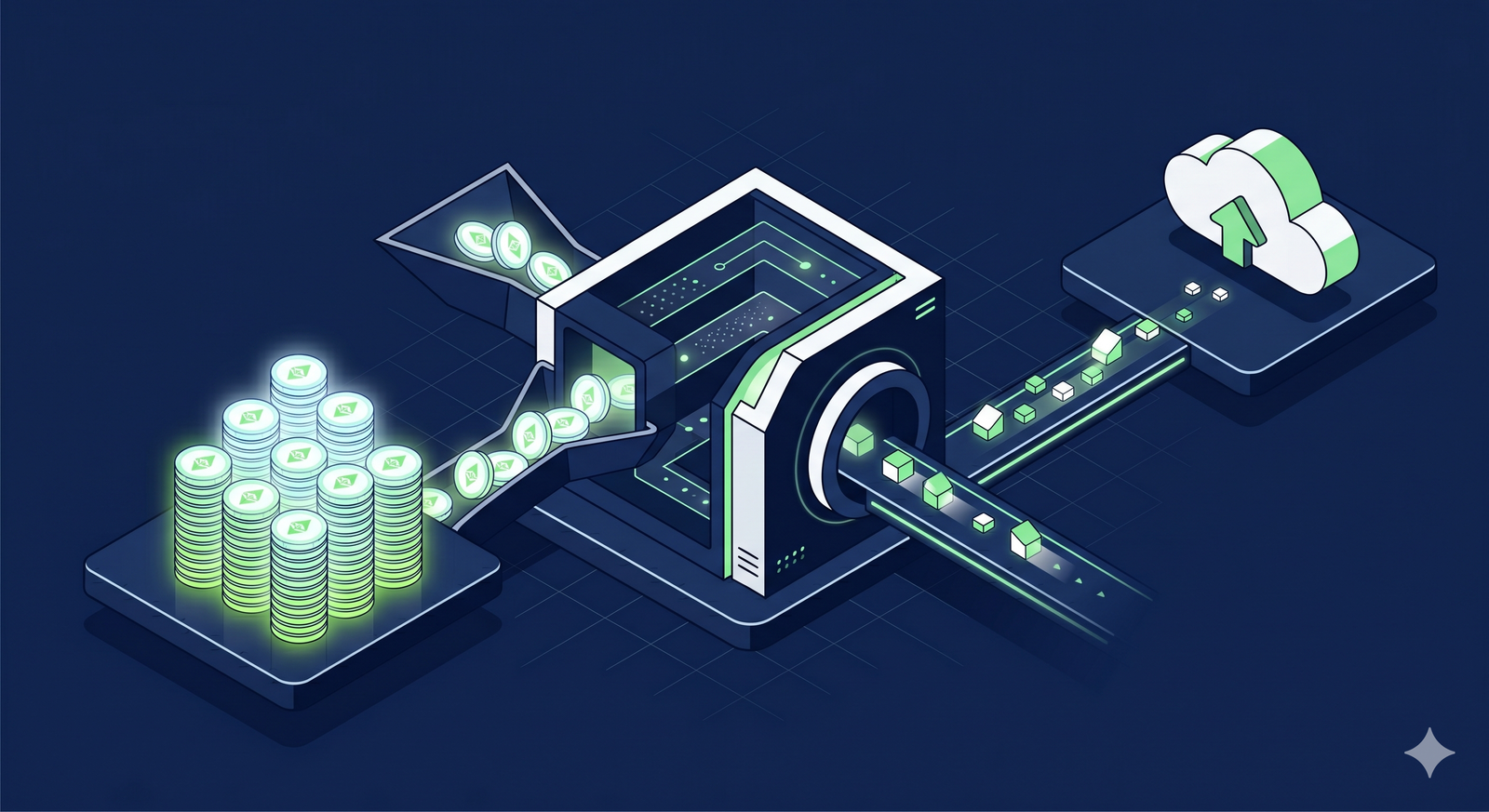
To reduce LLM API costs for a growing SaaS platform, engineering teams must implement semantic caching to serve repeat queries for free, route simple tasks to cheaper models, and heavily compress prompt context windows. As user volume scales, treating every user request as a zero-shot prompt to a flagship model like GPT-4 or Claude 3.5 Opus becomes financially unsustainable. By building an intelligent orchestration layer, SaaS founders can cut AI inference bills by over 70 percent while maintaining high response quality and reducing latency.
The Economics of Scale in AI Software
Traditional SaaS businesses benefit from near-zero marginal costs. Adding one more user to a database-backed web application costs fractions of a cent. Generative AI fundamentally breaks this economic model. Large Language Models (LLMs) incur significant compute costs for every single interaction, creating a variable cost of goods sold that scales linearly, or even exponentially if you are running multi-step agentic workflows.
According to a 2026 report by Gartner, the aggregated costs of model inference will account for at least 70 percent of total model lifetime costs by 2028. Many engineering teams stick with their production LLMs long after cheaper alternatives hit the market, a phenomenon called model inertia. While baseline API costs are dropping as hardware improves, overall spend continues to climb because product usage grows. For a mid-sized SaaS platform processing tens of thousands of daily interactions, an unoptimized AI architecture can quickly burn through venture capital runway.
To build a profitable AI product, you must transition from relying on raw model intelligence to relying on systems engineering. You need to stop paying frontier models to perform basic data processing.
Step 1: Implement Semantic Caching
Standard caching matches exact text strings. If a user asks a question, and another user asks the exact same question word-for-word, the database returns the stored answer without calling the AI. However, humans rarely ask questions the exact same way.
Semantic caching solves this. It converts incoming user queries into mathematical vector embeddings and compares them against previously answered queries using a cosine similarity threshold.
If User A asks, “How do I reset my account password?” the system generates an answer and caches it. If User B later asks, “What is the process to change my login password?”, the semantic cache identifies that the intent is 95 percent similar. It intercepts the request and serves User A’s cached response instantly.
For platforms with high query overlap, such as customer support tools or educational software, semantic caching can achieve hit rates of 61 to 68 percent. This eliminates the API call entirely, driving inference costs down to zero for those specific interactions while cutting latency from seconds to milliseconds.
Step 2: Deploy Intelligent Model Routing
Not every task requires the reasoning capabilities of the most expensive models on the market. Intelligent model routing acts as a triage system, classifying the complexity of an incoming query before deciding which API to call.
A tiered routing architecture typically splits traffic into three categories:
Fast Tier: Lightweight models like GPT-4o-mini or Llama 3 8B handle basic classification, sentiment analysis, and template filling. These cost pennies per million tokens.
Smart Tier: Mid-level models like Claude 3.5 Sonnet handle standard reasoning and content generation.
Power Tier: Expensive models like GPT-4 Turbo or Gemini Ultra are reserved strictly for complex logical deduction, deep coding tasks, or nuanced data extraction.
Industry data shows that routing 70 percent of traffic to the fast tier, 20 percent to the smart tier, and only 10 percent to the power tier can reduce average per-query costs by 37 to 46 percent. You can implement this by training a fast, cheap classifier model to read the prompt and assign a complexity score, which dictates the routing path.
Step 3: Prune Retrieval-Augmented Generation Pipelines
Retrieval-Augmented Generation (RAG) is the standard method for giving AI models access to your proprietary SaaS data. However, RAG pipelines are notorious for causing token inflation.
By default, many vector database implementations retrieve the top five to eight document chunks related to a query and stuff them into the LLM context window. If each chunk is 500 tokens, you are paying for 4,000 input tokens on every single request, even if the answer is located in the first sentence of the first chunk.
You must tune your retrieval system aggressively. Limit the context injection to the top two or three highly relevant chunks. Implement a re-ranking algorithm to filter out low-value text before it ever reaches the prompt. Cutting your input tokens by 50 percent immediately cuts your API input costs by half, with almost no loss in response accuracy.
Step 4: Constrain Output Lengths
Output tokens are typically three to four times more expensive than input tokens across major AI providers. If you do not explicitly constrain how much the model writes, it will naturally generate verbose, conversational filler.
Every unnecessary greeting, summary paragraph, or polite closing sentence is a recurring financial leak. Strip these out by adding strict instructions to your system prompt. Demand that the model answers concisely, outputs only the requested data, and refrains from conversational pleasantries. Additionally, set a hard max_tokens limit in your API payload. If the task only requires a one-sentence answer, cap the output at 50 tokens to prevent runaway generation.
Step 5: Control Automated Retry Loops
When integrating LLMs into automated software workflows, you will eventually encounter malformed JSON outputs or API timeouts. The standard engineering practice is to implement a retry loop that automatically triggers the request again.
When dealing with AI APIs, an uncontrolled retry loop is incredibly dangerous. If a complex prompt consistently confuses the model, causing it to return invalid code, a basic retry script might hit the API 20 times in a minute before giving up. You are billed for every failed attempt. Always implement strict retry limits, utilize exponential backoff, and set up billing alerts to catch cost anomalies caused by automated system failures.
Summary Table: Evaluating Cost Optimization Strategies
| Optimization Strategy | Cost Reduction Potential | Implementation Effort | Best SaaS Use Case |
| Semantic Caching | 40% to 68% | Medium | Customer support, documentation, FAQs |
| Model Routing | 30% to 50% | High | Multi-feature platforms, diverse query types |
| RAG Context Pruning | 20% to 40% | Low | Enterprise search, knowledge bases |
| Output Length Limits | 10% to 30% | Very Low | Chatbots, data extraction workflows |
| Open-Source Hosting | 50% to 80% | Very High | Massive scale, predictable workloads |
Case Study: Optimizing B2B Support Operations
Consider a rapidly scaling B2B support automation platform processing 50,000 conversations daily. Initially, the engineering team routed every message through a premium LLM to guarantee high-quality responses. As their user base grew, their API bill exceeded $10,000 per month, severely impacting their gross margins.
The team overhauled their architecture without changing the user experience. First, they implemented a semantic caching layer using vector embeddings. Because customer support queries are highly repetitive (e.g., billing questions, feature requests), the cache handled 45 percent of all traffic automatically.
For the remaining un-cached queries, they built a routing layer. They used a fast, inexpensive model to classify the intent of the message. If the message required a basic account status check, it was handled by a low-cost model. Only complex technical troubleshooting tickets were passed to the premium flagship model. By combining semantic caching and intelligent routing, the platform reduced its monthly inference costs from $10,000 to under $2,500, a 75 percent reduction, while actually improving the average response time for its users.
Actionable Next Steps
Scaling your SaaS platform’s AI capabilities does not have to mean scaling your infrastructure budget at the same rate. Here are three concrete steps you can take today to protect your margins:
- Audit your prompt verbosity. Review your system prompts and strip out unnecessary instructions. Add hard token limits to your API calls to prevent the model from generating expensive conversational filler.
- Implement an exact-match or semantic cache. If your platform answers similar questions frequently, put a database layer between the user and the API. Serve the repeat answers for free.
- Separate tasks by complexity. Stop using frontier models for basic data extraction. Route simple tasks to cheaper, faster models like GPT-4o-mini or Claude Haiku.
If your organization needs custom engineering help to audit your AI architecture, build semantic caching layers, or implement intelligent routing protocols, our AI & Data Science agency can assist. We build reliable, cost-efficient infrastructure for scaling businesses. Reach out to us at https://tensour.com/contact.
Leave a Reply