
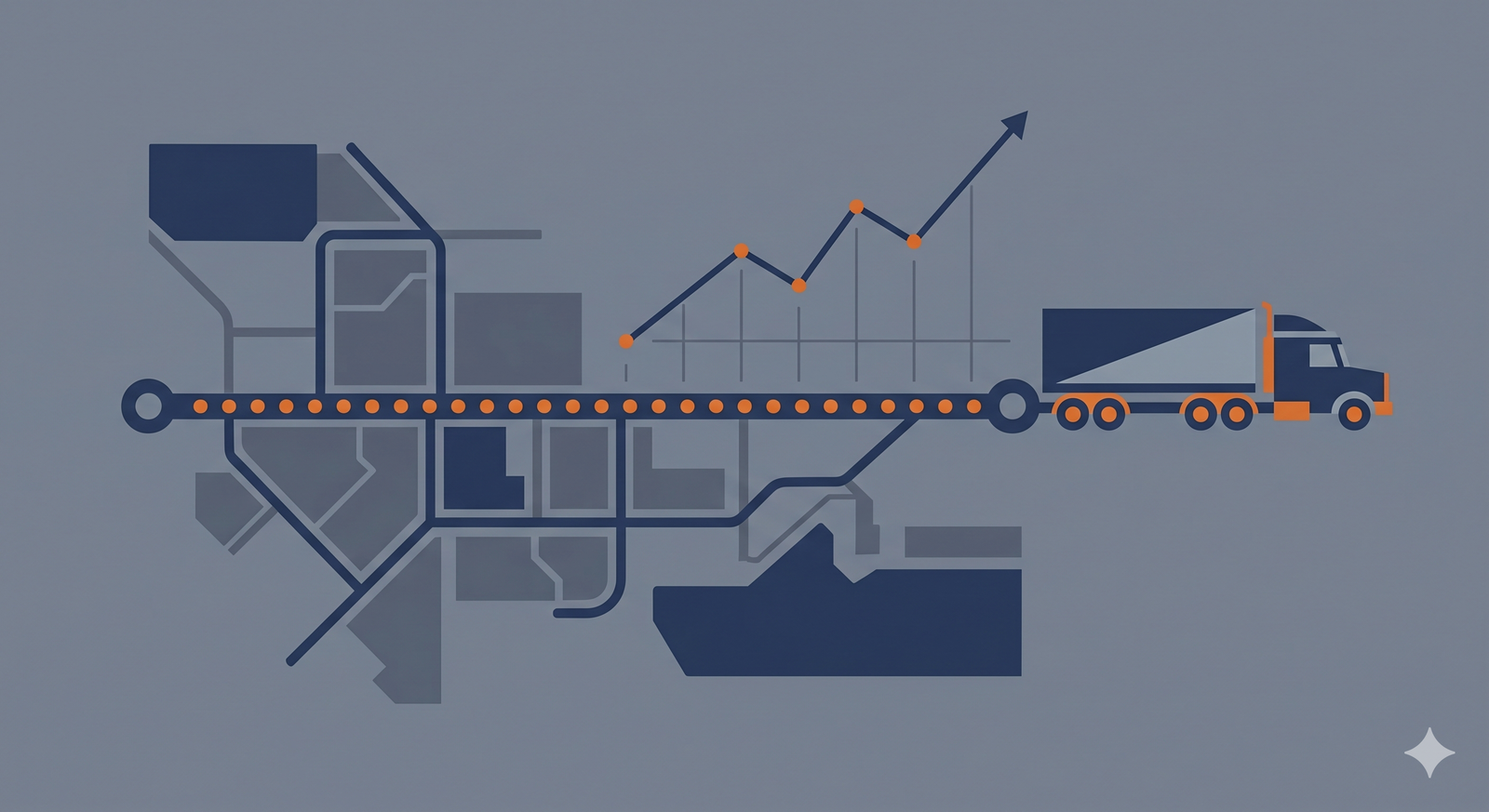
Predictive analytics reduces supply chain logistics costs by analyzing historical shipment data, real-time weather patterns, and IoT sensor telemetry to forecast exact transit times and optimal inventory routing. This mathematical forecasting allows companies to bypass structural bottlenecks before they happen, effectively eliminating the costs associated with excess inventory holding and reactive expedited shipping. The financial value is generated entirely by shifting a supply chain from a reactive tracking model to a proactive, mathematically optimized system.
Global logistics networks are highly sensitive to minor disruptions. A single port delay or sudden weather event can cascade into massive financial losses if a company relies purely on descriptive analytics. Descriptive analytics tells you where a truck is right now, but it cannot tell you if that truck will miss a critical transfer window tomorrow. To protect profit margins, modern supply chains require data architectures capable of continuous, automated foresight.
The Mathematical Shift in Freight Logistics
Traditional enterprise resource planning systems operate on static routing tables and historical averages. If a route historically takes four days, the system assumes it will take four days next week. This linear approach fails entirely in volatile environments. Predictive models replace these static averages with dynamic probabilities.
By ingesting massive datasets, these models calculate the exact probability of a delay based on thousands of intersecting variables. According to a comprehensive analysis on supply chain resilience by McKinsey & Company, companies that successfully implement AI-driven supply chain management reduce their inventory holding costs by 20 percent while simultaneously improving service levels by up to 65 percent. This is not achieved through better trucks, but through superior data analytics that prevents trucks from sitting idle.
Real-World Case Study: Cold Chain Logistics Optimization
To understand the mechanics of this technology, we can examine a large-scale third-party logistics provider specializing in cold chain distribution. Cold chain logistics involves transporting temperature-sensitive goods like pharmaceuticals and perishable foods. The profit margins are notoriously thin because any delay often results in total product spoilage.
Prior to implementing predictive modeling, this logistics provider faced a two-fold problem. First, unpredictable traffic and border delays were causing a 12 percent annual spoilage rate. Second, drivers were forced to idle their refrigerated trailers continuously during delays, resulting in massive diesel fuel waste. Management attempted to solve this by adding more buffer time into delivery schedules, which only increased overhead costs and frustrated clients.
Engineering the Predictive Architecture
The solution required building a centralized data lake to aggregate disparate data streams. The engineering team integrated internal transportation management system data with external APIs providing real-time weather forecasts, regional traffic density, and port congestion metrics.
Instead of relying on simple regression, the team deployed advanced machine learning algorithms. Specifically, they utilized XGBoost for tabular data prediction and Long Short-Term Memory networks to handle the time-series forecasting of temperature fluctuations inside the trailers. These models continuously calculated the optimal route for every single truck in the fleet, updating the routing instructions every fifteen minutes.
Furthermore, the company implemented computer vision at their cross-docking facilities. Cameras automatically scanned barcode labels and assessed trailer load capacities in real-time, feeding this physical dimension data directly back into the predictive routing algorithm to ensure no trailer departed underutilized.
The Quantifiable Financial Impact
The deployment of this predictive architecture produced immediate financial results. The system accurately predicted major traffic corridors and rerouted drivers before they became trapped, dropping the annual spoilage rate from 12 percent to under 3 percent.
More importantly, the route optimization heavily reduced fuel consumption. Research published by MIT Sloan Management Review indicates that advanced predictive routing reduces fleet fuel consumption by 10 to 15 percent annually. In this case study, the logistics provider achieved a 14 percent reduction in total fuel spend within the first eight months of production. The system paid for its initial development costs in less than two quarters entirely through fuel savings and reduced insurance claims on spoiled goods.
Step-by-Step Logic for Implementing Supply Chain AI
Deploying predictive analytics in a live logistics environment requires strict adherence to data engineering principles. You cannot apply machine learning to fractured, siloed data.
Step 1: Unify the Data Infrastructure
Extract data from your warehouse management systems, transportation management systems, and enterprise resource planning software. Centralize this into a scalable data warehouse. If your historical data is locked in unstructured supplier emails or PDF contracts, you must use natural language processing pipelines to extract and structure those key terms and delivery dates before moving forward.
Step 2: Define the Predictive Target
Do not attempt to optimize the entire supply chain at once. Select a specific, high-cost variable to predict. This could be predicting the exact time of arrival for inbound freight, forecasting the failure rate of forklift batteries, or predicting short-term regional demand spikes to optimize warehouse staffing.
Step 3: Deploy Models in Shadow Mode
Run your machine learning models in a shadow environment where they ingest live data and make predictions, but those predictions are not sent to the actual drivers or warehouse managers. Compare the AI’s predictions against what actually happened in reality. You only promote the model to production once its accuracy consistently beats your current human baseline.
Overcoming Infrastructure Constraints
The primary barrier to achieving the results seen in the cold chain case study is data drift. Supply chains are physical environments that change rapidly. A model trained on shipping data from 2022 will perform poorly in 2026 because trade routes, fuel prices, and consumer habits have shifted.
According to an operational report by Gartner, over 50 percent of supply chain organizations are actively investing in artificial intelligence, yet many fail to budget for ongoing model retraining. Predictive analytics requires continuous monitoring. When a model’s accuracy degrades due to changing real-world conditions, your engineering team must immediately retrain the algorithm on fresh data. This ongoing lifecycle management often requires custom AI development pipelines that automate the retraining process without human intervention.
Furthermore, the data quality must remain pristine. A study detailed by Harvard Business Review highlights that predictive models amplify bad data. If a supplier consistently inputs incorrect tare weights into your portal, the AI will confidently generate highly optimized, completely incorrect loading instructions.
Predictive Logistics Value Summary
Use this matrix to understand the structural differences between traditional and AI-driven logistics operations.
| Operational Metric | Traditional Logistics | Predictive Logistics | Direct Financial Impact |
| Route Planning | Static schedules, historical averages | Dynamic routing, real-time API ingestion | 10 to 15 percent reduction in fuel spend |
| Inventory Allocation | Reactive restocking based on empty shelves | Probabilistic forecasting of local demand | Eliminates expensive expedited freight costs |
| Equipment Maintenance | Schedule-based (e.g., every 10,000 miles) | Condition-based (IoT sensor anomalies) | Reduces vehicle downtime and catastrophic failures |
| Exception Handling | Manual phone calls and emails | Automated alerts and proactive rerouting | Drastically lowers human labor per shipment |
3 Actionable Next Steps
To begin reducing your logistics costs, you must immediately audit your data readiness.
- Calculate the exact cost of your supply chain exceptions over the last fiscal year. Identify how much capital was wasted on expedited shipping, overtime warehouse labor, and spoiled inventory to establish your maximum potential ROI.
- Audit your current software stack to determine if your transportation and warehouse management systems have open APIs capable of exporting real-time data to a centralized data lake.
- Select a single, high-frequency transport route and run a small-scale data collection pilot using IoT telemetry to build your first viable dataset.
Conclusion
Predictive analytics is the only mathematical method to protect logistics profit margins from external volatility. By structuring your supply chain data and deploying targeted machine learning models, you can accurately forecast disruptions, automate complex routing decisions, and significantly lower your operational overhead.
If you need technical expertise to unify your fragmented logistics data or require professional AI consulting and strategy to build predictive models tailored to your freight network, our team can assist. Tensour specializes in engineering robust data solutions for complex industrial environments. Visit https://tensour.com/contact to start building a resilient supply chain.
Leave a Reply