
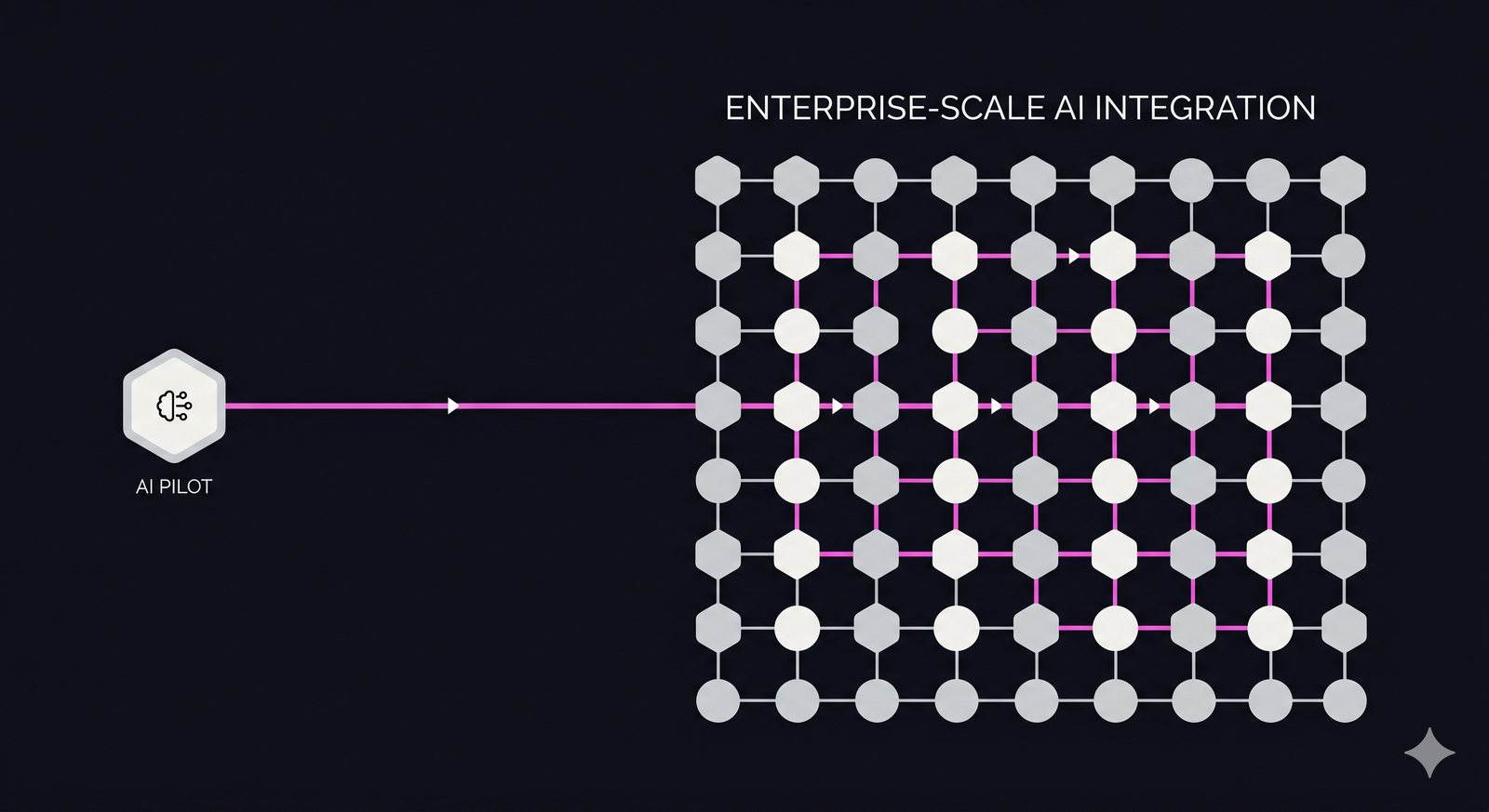
Scaling an AI pilot into operational integration means moving a working algorithm out of a controlled sandbox and embedding it directly into core business workflows. This process requires engineering robust data pipelines, establishing strict governance protocols, and aligning model outputs with specific financial goals. Consequently, this transition turns experimental projects into reliable, revenue-generating enterprise systems.
The Reality of the Artificial Intelligence Prototype Graveyard
Many enterprise teams build impressive machine learning models in isolated environments. Initially, these models perform exceptionally well on historical data. However, these prototypes rarely survive the transition into real-world production environments. This failure occurs because a clean, static dataset on a data scientist’s laptop does not resemble a messy, real-time data stream in a live server.
Therefore, bridging the gap between a successful pilot and a live deployment remains the hardest challenge in enterprise technology. Organizations must shift their focus from building algorithms to building infrastructure. Specifically, they must prioritize data analytics and software engineering over pure data science.
The industry data reveals a harsh reality regarding adoption rates. First, technology research firm Gartner reports that only 54 percent of AI projects successfully move from the pilot phase into production. Therefore, nearly half of all corporate investments in artificial intelligence currently yield zero operational return.
Furthermore, Accenture found that 76 percent of executives struggle significantly to scale AI across their broader business units. Consequently, these leaders remain stuck in a perpetual cycle of isolated experimentation.
Conversely, companies that successfully cross this chasm reap massive financial rewards. According to a global study by McKinsey & Company, organizations that successfully scale these technologies see up to a 20 percent increase in earnings before interest and taxes.
Finally, MIT Sloan Management Review notes that 70 percent of enterprises report minimal impact from their AI initiatives specifically because they fail to integrate the models into the daily workflows of their employees. Thus, successful integration is fundamentally a change management problem, not just a technical one.
Comparing the Pilot Phase to the Integration Phase
To understand how to move forward, leaders must understand the distinct differences between a sandbox experiment and a live system. The table below outlines the core differences between these two operational states.
| Feature | The AI Pilot Phase | Full Operational Integration |
| Data Source | Static, manually cleaned CSV files. | Live, automated data pipelines via APIs. |
| Infrastructure | Local machines or isolated cloud instances. | Scalable, highly available cloud architecture. |
| Maintenance | Manual updates by a single data scientist. | Automated retraining pipelines via MLOps. |
| Business Focus | Proving the algorithmic concept works. | Generating measurable ROI and efficiency. |
| User Experience | Accessed via command line or basic dashboards. | Embedded directly into enterprise software. |
Step-by-Step Logic for Scaling AI to Production
Transitioning from a sandbox to a production environment requires rigorous engineering discipline. You cannot simply copy and paste code onto a live server. Instead, you must follow a structured, sequential deployment framework. An effective AI consulting strategy relies on these exact operational steps.
Step 1: Standardize Your Enterprise Data Pipelines
First, you must address your data infrastructure. An algorithm is only as reliable as the data feeding it. During a pilot, engineers often manually clean the data. However, in production, the data flows continuously. Therefore, you must build automated pipelines that extract, clean, and load data in real-time.
Additionally, you must implement strict data quality checks. If corrupt data enters the system, the model will output incorrect predictions. Consequently, establishing robust data engineering protocols is the absolute prerequisite for scaling any machine learning model.
Step 2: Implement Robust MLOps Practices
Next, you must deploy Machine Learning Operations, commonly known as MLOps. MLOps is the standardized process of taking machine learning models to production securely. Specifically, it involves versioning your data, tracking your model experiments, and automating the deployment process.
Furthermore, MLOps ensures that your code remains modular and testable. When you utilize professional custom AI development, the engineering team builds continuous integration and continuous deployment pipelines. Thus, when an engineer updates the model, the system automatically tests it before pushing it to the live server.
Step 3: Redesign User Workflows for Seamless Adoption
Subsequently, you must focus on the human element. Even the most accurate computer vision system is useless if employees refuse to use it. Therefore, you must integrate the AI directly into the tools your staff already use daily.
For instance, do not force an employee to log into a separate portal to see an AI prediction. Instead, push that prediction directly into their existing CRM or ERP dashboard. Consequently, you reduce friction and drastically increase the adoption rate among your workforce.
Step 4: Establish Continuous Monitoring and Retraining
Finally, you must monitor the model after deployment. Machine learning models degrade over time. As market conditions shift and customer behaviors change, the live data diverges from the training data. Engineers call this phenomenon data drift.
Accordingly, your operational integration must include automated monitoring tools. These tools alert your team when the model’s accuracy drops below a specific threshold. Consequently, the system can automatically trigger a retraining cycle using the most recent data, ensuring the algorithm remains accurate and reliable over the long term.
Enterprise Case Study: Scaling Predictive Supply Chains
Real-world examples highlight the value of this structured approach. Consider the operational challenges faced by a massive global retail brand managing thousands of stores. Initially, their data science team built a highly accurate predictive algorithm to forecast inventory demand. During the pilot phase, this algorithm successfully predicted stock shortages in a dozen test stores.
However, scaling this pilot to three thousand global locations presented a monumental engineering challenge. First, the core engineering team discarded the manual data extraction process used in the pilot. Instead, they built automated data pipelines connecting point-of-sale systems directly to their cloud infrastructure.
Next, they implemented strict MLOps protocols. Because consumer demand varies wildly between different regions, deploying a single global model was impossible. Therefore, the automated MLOps pipeline trained and deployed three thousand individual micro-models, one for each specific store location.
Furthermore, the company embedded the model outputs directly into the handheld devices used by store managers. Consequently, managers did not have to interpret complex data charts. They simply received a daily automated alert detailing exactly which items to restock. Ultimately, this full operational integration reduced out-of-stock incidents by thirty percent and significantly increased global revenue.
The Commercial Reality: What Enterprise AI Cannot Do
Despite the massive potential of artificial intelligence, business leaders must remain completely honest about its practical limitations. AI is mathematically driven pattern recognition. It is not an autonomous, sentient employee.
Specifically, integrating an advanced algorithm will not fix a fundamentally broken business process. If your supply chain strategy is deeply flawed, an AI will simply execute that flawed strategy faster. Furthermore, machine learning models cannot instantly repair fragmented, undocumented legacy databases. You still have to do the hard work of migrating and organizing your enterprise data.
Additionally, artificial intelligence lacks common sense. When unprecedented market events occur, historical data becomes entirely useless. In these black swan scenarios, predictive models will confidently generate incorrect outputs. Therefore, human oversight, critical thinking, and manual override capabilities must remain permanently embedded in your operational architecture.
Actionable Next Steps for IT Leaders
To successfully move your enterprise initiatives out of the pilot phase, you must take concrete, immediate action. Start by executing these three specific steps today.
- Audit your current AI pilot programs and immediately shut down any projects that do not clearly map to a measurable financial objective or operational efficiency.
- Meet with your data engineering team to map out the exact infrastructure requirements needed to automate the data feed for your most successful pilot.
- Establish a formal MLOps committee within your IT department to define strict standards for model deployment, version control, and continuous monitoring.
Moving from isolated pilots to full operational integration dictates the future success of your enterprise. By prioritizing data pipelines, adopting MLOps, and focusing on user adoption, you transform experimental code into a tangible business asset. If you need custom engineering help implementing these production-grade systems, our AI and Data Science agency can assist you. Visit https://tensour.com/contact to schedule a technical architecture review.
Leave a Reply