
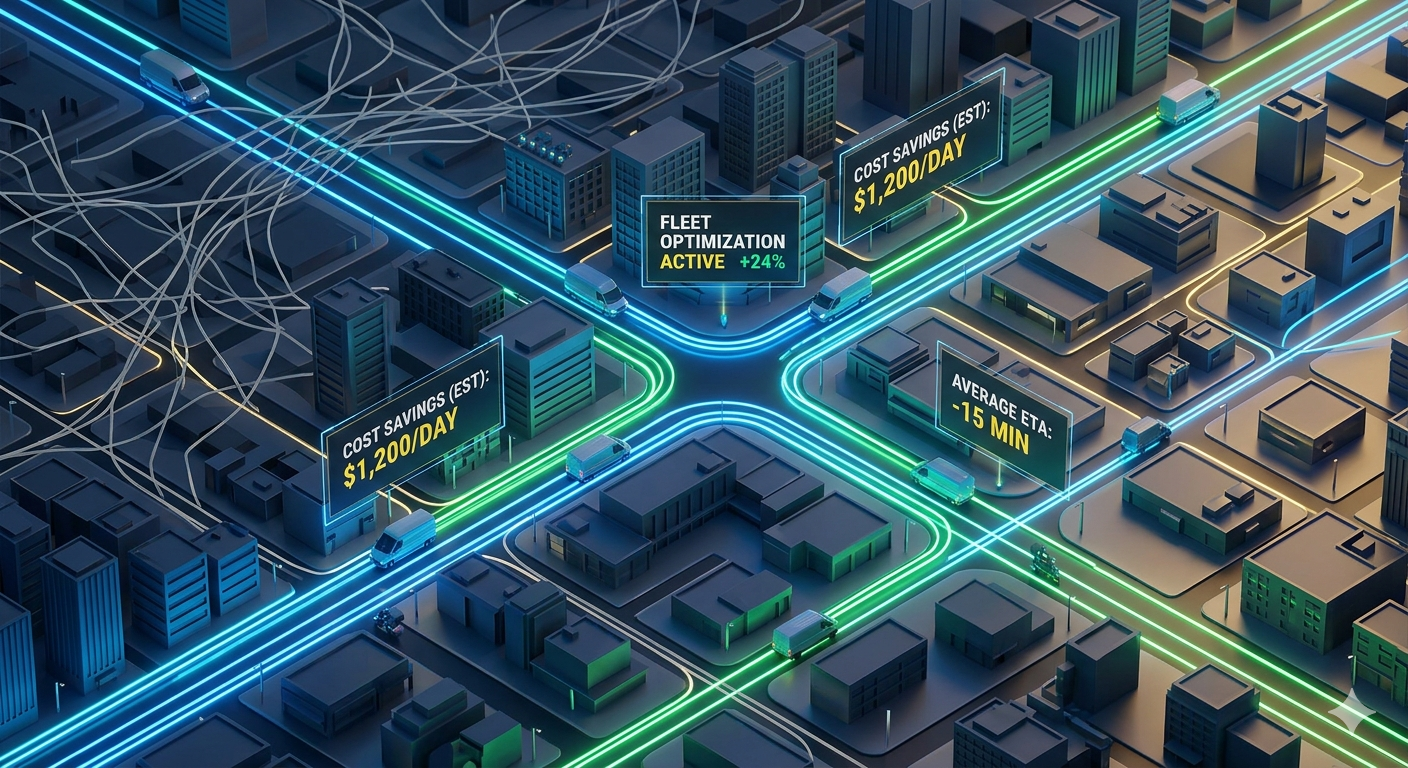
How do modern platforms like Uber, DoorDash, and Delivery Hero manage and route thousands of vehicles in real-time?
At this scale, manual planning is not just inefficient; it is functionally impossible. Managing a fleet of just 50 vans and 500 customers across a bustling city quickly turns into an impossible computational puzzle. Without automated systems, dispatchers face daily chaos, leading to systemic failures, missed delivery windows, and spiraling fuel budgets.
The “prize” for solving this problem isn’t just operational ease; it’s quantifiable engineering and business transformation:
- 20% to 30% average reduction in total fleet costs and fuel consumption.
- 15%+ increase in fleet utilization, allowing operators to do more with fewer vehicles and drivers.
- Dramatically improved customer satisfaction through accurate and predictable ETAs.
Moving past intuition requires building a custom dispatch and navigation engine. This article provides a comprehensive look at the production-grade architecture required to pair open-source mapping intelligence with advanced mathematical solvers, creating a system that matches the performance of the world’s leading logistics giants, without the associated API costs
How do you deliver packages to customers in the most optimized, fastest, and cheapest way possible?
More specifically: Which vehicle should deliver to which customers, in what order, and along which paths to minimize fuel costs, respect driver operating hours, and keep customers happy?
At its core, this challenge is a classic Vehicle Routing Problem (VRP). In modern operations, we must solve a specialized version: the Time-Bounded Capacitated Vehicle Routing Problem (CVRP). A robust solution requires defining and simultaneously optimizing multiple, conflicting real-world constraints:
- Capacity: Vehicles have limits (weight or volume). A van carrying 3,000 kg will reach maximum payload, forcing it to return to a depot and spawn new routes or assignments.
- Time Windows: Driver shift hours (e.g., maximum 8 operating hours per day) must be respected. We must account for driving time between locations and significant unload/service delays at each stop (e.g., 20 minutes for a multi-story building).
- Cost Structures: A smart dispatch engine minimizes total cost, which is composed of both fixed costs (the flat price to activate a vehicle and driver) and variable costs (the cost per kilometer traveled). By quantifying both, the system must make intelligent trade-offs. Is it cheaper to pay the fixed fee to rent a third vehicle, or pay the extra mileage to expand an existing driver’s route?
Visualizing the Routing Puzzle
To make this concrete, let’s look at a simple scenario. Imagine you have a central depot and three customers (A, B, and C) with different demands and travel times:
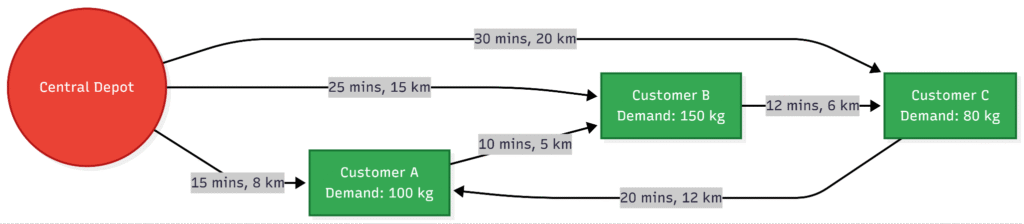
If your delivery van only has a capacity of 200 kg, it cannot serve all three customers in a single trip (total demand = 330 kg). It must return to the depot to reload.
- Which route should the van take first to minimize travel time?
- Should it serve Customer A and C first (100 kg + 80 kg = 180 kg), return to Depot, and then serve Customer B (150 kg)?
- How do driving times and distance change when real road networks are factored in?
This is exactly what automated dispatch engines solve.
In this article, we will go behind the scenes of how modern tech companies build their own custom, high-performance fleet routing and map systems. We will look at a production-grade architecture that pairs open-source mapping engines with advanced optimization solvers to route fleets efficiently—without the enterprise price tag.
The Real-World Constraints: What the Algorithm Must Solve
Before writing any code, we need to define the rules of the road. In a real-world dispatch system, route optimization must balance several conflicting constraints:
- Load Constraints (Capacity): Vehicles have weight or volume limits. A van cannot carry more than its maximum payload.
- Time Constraints (Shift Hours): Drivers can only work a set number of hours per day. Routes must account for both driving times and unloading delays at customer locations.
- Cost Constraints (Fleet Budgets): Fleet costs involve a mix of fixed costs (flat rate for starting a vehicle) and variable costs (cost per kilometer traveled).
- Speed & Vehicle Constraints: Different vehicles (e.g., motorbikes vs. trucks) move at different average speeds and are restricted from certain roads.
The Core Tech Stack: The Brain and the Senses
To build a dispatch system that feels alive, you need two core capabilities:
- 1. The Senses (Geospatial & Map Intelligence): Understanding map data, road networks, actual driving times, restrictions, and traffic behaviors.
- 2. The Brain (Optimization Engine): Evaluating millions of possible combinations of routes to find the most cost-effective solution under strict constraints.
A typical self-hosted stack uses:
- OSRM (Open Source Routing Machine): A high-performance routing engine written in C++ that runs on OpenStreetMap (OSM) data. It is the “senses” of our application, generating massive distance and duration tables in milliseconds.
- Google OR-Tools: An open-source suite for combinatorial optimization. It acts as the “brain,” using advanced heuristics to solve routing problems.
- Flask (Python): A lightweight API layer to orchestrate requests, run the solver, and expose service endpoints.
- Folium / Leaflet.js & Streamlit: Interactive visualization layers. Operators can view maps via Streamlit-based dashboards integrated with Leaflet to track vehicle routes and delivery sequences.
System Architecture: The Overall Dispatch Flow
How do these systems talk to each other? The diagram below outlines the request-response lifecycle when a dispatcher triggers route generation.
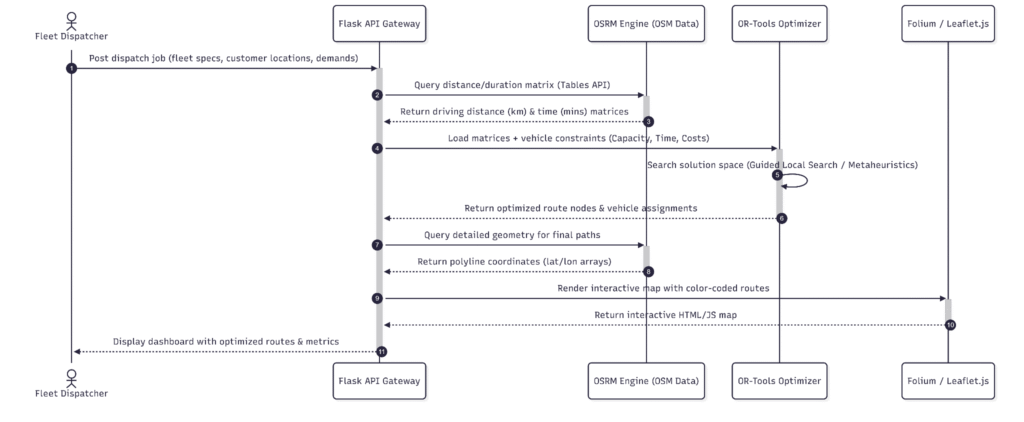
Step 1: Getting Real-World Road Networks (OSRM Tables API)
To plan routes, the solver needs to know the exact road distance and travel duration between every single pair of locations (e.g., between the warehouse and Customer A, between Customer A and Customer B, and so on).
If you have 20 locations, that is a $20 times 20$ matrix (400 pairs). If you have 100 locations, it is a $100 times 100$ matrix (10,000 pairs).
Instead of making 10,000 separate routing requests, we use OSRM’s Table API. By supplying all coordinates in a single HTTP request, OSRM queries its memory-mapped road graph and returns the complete distance and duration matrices in a fraction of a second.
Why Vehicle Profiles Matter
Vans, motorbikes, and heavy-duty trucks do not travel at the same speed or use the same roads. OSRM supports different routing profiles (e.g., `car`, `truck`, `Bike`). In a production system:
- Truck profiles avoid narrow residential streets and low-clearance bridges.
- Bike profiles factor in faster maneuvers through congested city streets.
- Unified profiles use average speeds and custom road factors to scale estimated durations based on vehicle category.
Step 2: The Core Optimization Engine (OR-Tools Solver)
Translating business logic into mathematical constraints that the solver can work with is complex. Once the solver has the matrix data, it must navigate the impossible optimization landscape. A production system cannot wait hours for an answer.
Finding the mathematically “best” solution for 500 stops is almost impossible. Instead, we must configure the solver to find a 99% optimal solution in 30 seconds. This balance is critical for operational agility.
This requires expertise in configuring OR-Tools with customized metaheuristics, such as Guided Local Search, and carefully tuning time limits. This level of solver performance tuning is a unique skill set, distinct from just writing good Python code. It demands a background in operations research and algorithmic optimization.
Step 3: Translating Business Logic into Mathematical Constraints
With our constraints defined upfront, the routing solver translates these business rules into mathematical constraints:
1. Capacity Constraints
Every vehicle has a maximum weight or volume limit (e.g., a delivery van carrying up to 3,000 kg). The solver must ensure that the sum of customer demands on any given route never exceeds the vehicle’s capacity.
If a vehicle fills up, the solver forces it to return to the depot, and assigns the remaining deliveries to another vehicle.
2. Time and Operating Hours Constraints
Drivers have shift limits (e.g., maximum 8 operating hours per day). The travel time between locations, combined with service times (e.g., 30 minutes loading at the warehouse, 20 minutes unloading at each customer stop), must fit within this window.
If the total duration exceeds the driver’s limit, the solver will split the route or assign a new vehicle.
3. Fleet Cost Structure (Fixed vs. Variable)
A smart dispatch engine minimizes total cost, not just distance. The cost model typically has two parts:
- Fixed Cost: The flat rate incurred just for starting a vehicle’s engine (e.g., driver wages, vehicle rental fees).
- Variable Cost: The cost per kilometer (e.g., fuel consumption, wear and tear).
By including both in the cost evaluator, the solver makes intelligent decisions: Is it cheaper to pay a flat fee to rent a second vehicle, or should we pay the extra mileage cost to have our owned vehicle make a longer journey?
Step 4: Visualizing the Dispatch Plan
Using Python mapping libraries like Folium (built on Leaflet.js), we can take the raw node sequences returned by the solver, call the OSRM Route API to retrieve the exact street-level coordinates (polylines), and render them on an interactive map.
- Each route gets a unique, vibrant color.
- Markers show the sequence numbers (e.g., stop 1, stop 2, stop 3) so drivers know the optimal drop-off order.
- Depot locations are clearly highlighted as the beginning and end of each journey.
Take Control of Your Logistics Architecture
Using the techniques and open-source tools detailed in this guide, you can easily design and deploy a custom route optimization system. This gives your organization a systematic advantage—slashing fuel budgets, improving fleet utilization, and scaling delivery capacity without incurring massive map API bills.
If you are looking to build a custom dispatch system or integrate advanced route optimization into your existing platform, feel free to reach out. We specialize in building custom mapping systems, fleet solvers, and real-time navigation pipelines for companies looking to automate their logistics operations. Let’s discuss how to bring optimized routing to your business!
Maps Route Optimization and Navigation System
This technical specification outlines the architecture and functional requirements for a high-concurrency route optimization and real-time navigation platform, modeled after industry leaders such as Uber and Delivery Hero.
1. Executive Summary
The objective of this system is to provide a seamless, end-to-end logistics and transportation management solution. By leveraging advanced geospatial algorithms and real-time data processing, the platform optimizes delivery routes, reduces fuel consumption, and enhances user satisfaction through precise ETA predictions and live tracking.
2. Core Functional Modules
The system architecture is divided into three primary interfaces to cater to all stakeholders within the ecosystem.
2.1 Customer Interface (Rider/Ordering App)
- Geocoding & Autocomplete: Seamless address entry using Google Maps Places API for pinpoint accuracy.
- Real-time Fare/Quote Estimation: Calculations based on distance, traffic density, and peak-hour multipliers.
- Live Tracking: Visual representation of driver movement via WebSocket connections.
2.2 Provider Interface (Driver/Courier App)
- Turn-by-Turn Navigation: Integrated in-app navigation with voice assistance.
- Batching & Pooling: Intelligent grouping of multiple orders to maximize efficiency per trip.
- Dynamic Rerouting: Real-time adjustments based on road closures or traffic incidents.
2.3 Administrative Interface (Dispatch Panel)
- Fleet Overview: Bird’s-eye view of all active units and their status.
- Manual Override: Ability to reassign tasks or modify routes in exceptional circumstances.
- Reporting & Analytics: Deep dives into KPIs such as average delivery time and driver utilization rates.
3. Technical Infrastructure
The platform utilizes a modern tech stack designed for low latency and high availability.
| Component | Technology | Purpose |
|---|---|---|
| Maps Engine | Google Maps Platform | Routing, Geocoding, and Navigation SDKs |
| Backend | Node.js / Go | High-concurrency request handling |
| Database | PostgreSQL + PostGIS | Geospatial data storage and indexing |
| Deployment | AWS / GCP | Cloud infrastructure and auto-scaling |
4. Fleet Route Optimization Logic
The core value proposition lies in the optimization engine which solves the Vehicle Routing Problem (VRP).
4.1 Optimization Parameters
- Time Windows: Ensuring deliveries are made within requested customer slots.
- Capacity Constraints: Matching order volume with vehicle payload limits.
- Traffic Intelligence: Incorporating historical and predictive traffic data for accurate ETAs.
4.2 Algorithm Workflow
- Initial Clustering: Grouping orders by proximity.
- Sequencing: Determining the optimal order of stops to minimize total distance.
- Assignment: Matching the route to the nearest available and suitable driver.
5. Security and Compliance
- Data Encryption: TLS/SSL for data in transit and AES-256 for data at rest.
- Privacy: Masking customer phone numbers and specific address details until a trip is active.
- Regulatory Compliance: Adherence to regional data protection laws (e.g., GDPR, CCPA).
6. Project Roadmap
- Phase 1: Core API development and Google Maps/OpenStreetMap integration.
- Phase 2: Driver and Rider app MVP development.
- Phase 3: Advanced route optimization algorithm tuning.
- Phase 4: Beta testing and regional rollout.
Conclusion: Engineering a Systematic Logistics Advantage
By utilizing the framework and open-source foundation detailed in this guide, you can design and deploy a custom route optimization system that gives your organization a systemic advantage slashing fuel budgets, maximizing fleet utilization, and scaling capacity without incurring massive map API costs.
If you are looking to build a custom dispatch system from scratch, integrate advanced route optimization into your existing platform, or need specialized expertise to tune your existing optimization solvers for production, let’s connect. I specialize in building custom mapping systems, fleet solvers, and real-time navigation pipelines that automate and master optimized routing at scale. Contact me to discuss how to bring advanced logistics engineering to your business.
Leave a Reply