
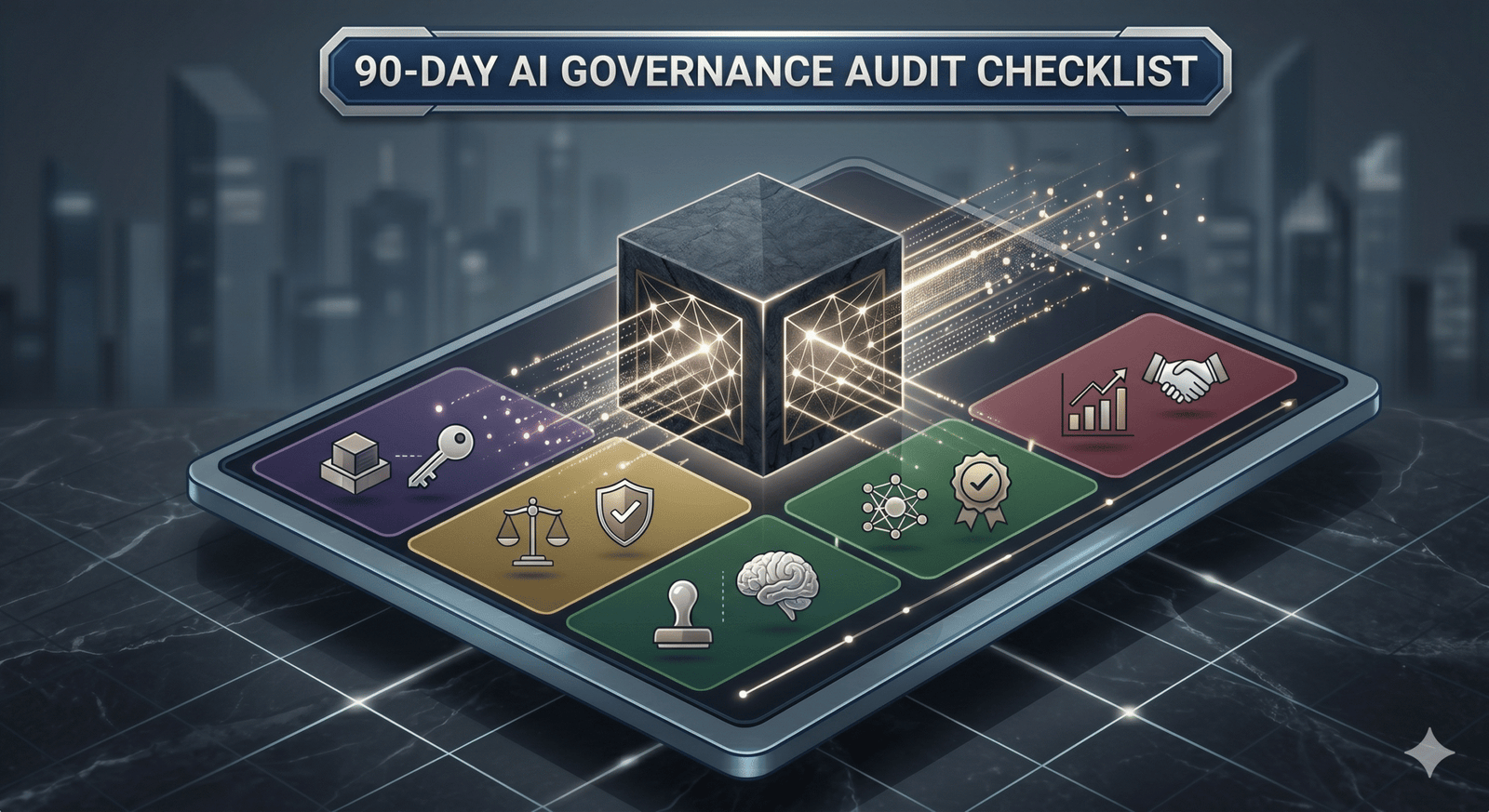
A 90-day AI governance audit checklist systematically evaluates your machine learning pipelines to ensure data privacy, algorithmic fairness, and strict regulatory compliance. Initially, it breaks the complex auditing process into distinct monthly phases focusing strictly on asset inventory, risk assessment, and automated policy enforcement. By following this structured framework, your data team can confidently deploy advanced models without exposing the broader enterprise to severe legal or operational liabilities.
The Urgency of Enterprise AI Risk Management
Currently, many engineering teams deploy machine learning models faster than their security departments can review them. Consequently, this rapid deployment creates a massive accumulation of technical and regulatory debt. When a language model or predictive algorithm processes sensitive customer data without oversight, the organization inherently risks disastrous privacy breaches and severe algorithmic bias.
Data clearly supports this architectural reality. According to a comprehensive market analysis by Gartner, organizations that effectively operationalize AI transparency and trust will successfully achieve a 50% improvement in terms of adoption and business goals by 2026. Furthermore, the IBM Cost of a Data Breach Report explicitly highlights that security breaches involving deeply integrated AI systems drastically increase financial penalties if the company lacks documented governance protocols. Therefore, establishing an AI compliance checklist for data teams is no longer optional; it remains strictly mandatory for corporate survival.
Month 1: Model Inventory and Architecture Mapping
You cannot govern systems that you do not know exist. Therefore, the first 30 days of your audit must focus entirely on discovery and documentation. Shadow AI represents a massive vulnerability inside modern corporate networks.
Step 1: Catalog Every Active Model
First, your engineering leaders must identify every single machine learning model currently operating in production. You must look beyond the official software repositories. Specifically, you need to interview department heads to find third-party vendor APIs, experimental scripts running on local machines, and isolated predictive models.
Step 2: Map the Data Lineage
Next, you must document exactly where each model sources its training and inference data. The audit team needs to trace the data lineage backward from the final output all the way to the raw database ingestion point. If your team discovers models processing personally identifiable information without proper anonymization, you must halt those specific pipelines immediately. Deep data analytics workflows depend entirely on secure, traceable data foundations.
Step 3: Define Clear Business Owners
Finally, assign a specific human owner to every documented algorithm. Algorithms do not pay regulatory fines; humans do. Therefore, an explicitly named product manager or lead data scientist must take ultimate responsibility for the ongoing performance and safety of their respective model.
Month 2: Risk Assessment and Algorithmic Bias Testing
Once you fully understand your technical inventory, the second month shifts toward rigorous vulnerability testing. This phase separates harmless internal automation scripts from high-risk customer-facing applications.
Step 4: Execute Bias and Fairness Evaluations
During this step, your engineers must rigorously evaluate the underlying training data for statistical bias. Specifically, you should measure metrics like disparate impact to ensure the algorithm does not actively discriminate against protected demographic classes. This becomes incredibly critical when building advanced NLP systems that process human language and potentially absorb historical human prejudices.
Step 5: Conduct Adversarial Vulnerability Testing
Subsequently, the security team must actively attack your machine learning endpoints. They should inject malformed data, attempt prompt injection on language models, and try to extract sensitive training data through the public API. If your infrastructure utilizes deep learning for visual tasks, your team must test your computer vision and AI image detector systems against adversarial pixel perturbations.
Step 6: Classify Models by Risk Tier
Ultimately, you must assign a specific risk tier to every model based on the assessment results. You can heavily leverage external standards like the NIST AI Risk Management Framework or the ISO/IEC 42001 Standard to structure this classification. Low-risk tools require minimal oversight, whereas high-risk financial or medical algorithms demand continuous, heavy monitoring.
Month 3: Policy Enforcement and CI/CD Integration
The final 30 days focus entirely on operationalizing your findings. Governance only works if you successfully integrate it directly into the daily developer workflow. Manual compliance checks simply do not scale.
Step 7: Update CI/CD Deployment Pipelines
Initially, you must program your continuous integration and continuous deployment pipelines to block non-compliant models automatically. For instance, if a developer attempts to merge a model that fails the automated fairness checks established in Month 2, the pipeline must reject the code commit. This strict automation ensures that governance remains a physical barrier, not just a written suggestion. Secure custom AI development heavily relies on these automated guardrails.
Step 8: Establish Human-in-the-Loop Thresholds
Furthermore, you must define strict confidence thresholds for your production algorithms. If a predictive model outputs a result with a statistical confidence level below 85%, the system must automatically route the decision to a human operator. You absolutely cannot allow uncertain machine learning models to make final, unreviewed business decisions.
Step 9: Finalize Incident Response Plans
Finally, draft a concrete incident response plan specifically tailored to algorithmic failures. Traditional software outages require restarting servers; AI failures often require issuing public apologies and retraining complex neural networks. Therefore, your team must know exactly who to call and which kill-switches to pull the second an algorithm begins generating toxic or financially destructive outputs.
Case Study: Securing Algorithmic Credit Scoring
Consider a mid-sized regional bank that recently deployed a proprietary algorithmic credit scoring system. Initially, their data science team focused entirely on predictive accuracy, successfully ignoring enterprise AI risk management protocols. Consequently, internal auditors soon noticed a severe statistical anomaly regarding loan approval rates for certain geographic zip codes.
According to guidelines published by the Brookings Institution, algorithmic redlining often occurs when models rely heavily on proxy variables. To resolve this, the bank initiated a strict 90-day AI governance audit. During Month 2, the engineering team discovered that the model relied heavily on historical training data that contained localized historical biases.
Subsequently, they completely refactored their machine learning pipeline. They implemented strict dataset anonymization, actively removed the biased proxy variables, and added continuous fairness monitoring scripts to their CI/CD pipeline. Ultimately, this rigorous governance implementation allowed the bank to pass federal regulatory scrutiny while simultaneously increasing their legitimate loan approval volume by 14%.
Summary Table: The 90-Day Governance Matrix
To consolidate this procedural timeline, carefully review the structured framework below. It clearly outlines the primary objectives and exact deliverables for each distinct auditing phase.
| Phase Timeline | Primary Objective | Key Engineering Deliverables | Core Stakeholders |
| Month 1 (Days 1-30) | Asset Discovery & Lineage | Centralized Model Registry, Data Flow Diagrams, Ownership Matrix. | Data Engineers, Product Managers. |
| Month 2 (Days 31-60) | Vulnerability & Bias Testing | Bias Assessment Reports, Adversarial Attack Logs, Risk Tier Classifications. | Data Scientists, Security Analysts. |
| Month 3 (Days 61-90) | Automation & Enforcement | Automated CI/CD Guardrails, Fallback Protocols, Incident Response Documentation. | DevOps Engineers, Legal Compliance. |
The Financial Reality of Non-Compliance
Moreover, executive leaders must understand that avoiding governance directly destroys corporate value. The European Union AI Act and similar global regulations now impose massive financial penalties for deploying unregulated, high-risk systems. Essentially, you are no longer just risking bad PR; you are actively risking significant percentages of your global revenue.
Consequently, building a strong culture of documentation and testing proactively shields your organization. When regulators eventually arrive to audit your systems, handing them a complete, mathematically verified 90-day audit log demonstrates clear institutional maturity.
Actionable Next Steps
To immediately secure your internal AI infrastructure today, strictly execute these three proven steps:
- Create a centralized spreadsheet today. Immediately mandate that every engineering lead input the name, purpose, and data source of every single model currently operating in their respective department.
- Select one high-risk model for immediate testing. Do not wait for Month 2 to begin testing your most critical asset. Run an open-source bias evaluation tool against your highest-revenue algorithm by the end of this week.
- Draft a hard “kill-switch” policy. Document the exact technical procedure required to safely take your primary AI systems offline in the event of an unexpected behavioral hallucination.
If your data team needs expert engineering assistance auditing, securing, and deploying compliant machine learning architecture, our specialized AI and Data Science agency stands ready to assist. Reach out to our technical team at https://tensour.com/contact. For broader organizational alignment, we additionally offer dedicated AI consulting strategy to help your executive board navigate complex regulatory landscapes safely.
Leave a Reply