
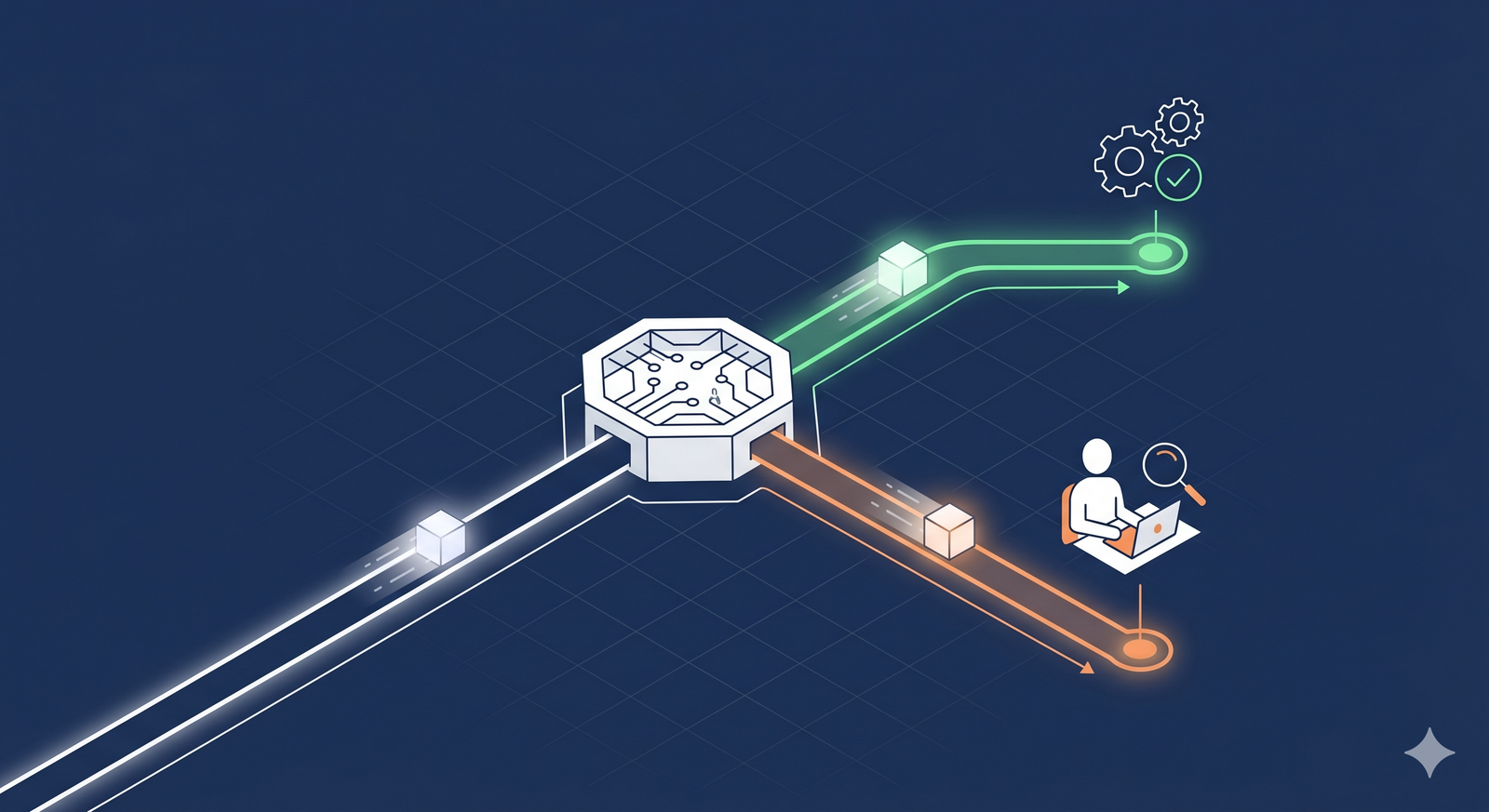
To ensure AI agents make safe decisions in enterprise workflows, engineering teams must design deterministic business rules that automatically route high-risk actions to human approvers and flag operational exceptions for manual review. By setting strict confidence thresholds and hardcoded logic gates, companies prevent probabilistic AI models from executing unauthorized or non-compliant tasks. This structured approach allows organizations to scale automation while maintaining absolute control over sensitive business outcomes.
The State of Agentic AI and the Need for Governance
The transition from passive AI chatbots to autonomous AI agents is happening faster than most enterprises anticipated. According to a recent report by Gartner, 40 percent of enterprise applications will feature task-specific AI agents by the end of 2026, a massive jump from less than 5 percent in 2025. These are not just conversational interfaces; they are systems designed to execute end-to-end tasks across your software stack.
However, giving a large language model read and write access to your databases introduces significant risk. Generative AI is inherently probabilistic. It guesses the next most likely token based on training data. Business operations, such as financial compliance, medical data handling, or access provisioning, require strict determinism.
If an AI agent decides to approve a high-value vendor invoice without a matching purchase order because the context window missed a detail, the financial damage is immediate. This is why human-in-the-loop architecture and explicit business rules are mandatory for production-grade AI engineering.
Why Business Rules Must Constrain AI Agents
You cannot rely on a language model to reliably police its own actions through prompt engineering alone. A system prompt instructing an agent to never approve invoices over a specific amount is a soft constraint. It can be bypassed by prompt injection, unexpected data formats, or model hallucinations.
Instead, AI engineers must decouple the decision-making logic from the text-generation model. The AI should act as a data extractor and synthesizer, returning structured data objects. A traditional deterministic rule engine, sitting outside the AI model, evaluates that structured data and dictates the routing.
If the AI outputs a requested discount of 25 percent, the external Python script or rule engine triggers a hardcoded exception. The agent is paused, and the workflow is routed to a human manager. This creates a secure boundary where the AI handles the heavy lifting of reading documents and drafting responses, but humans hold the keys to execution.
Step-by-Step Logic: Designing the Exception Routing Workflow
Implementing a robust routing and exception handling system requires mapping out your entire data pipeline. Here is the technical approach to building these guardrails.
Step 1: Identify irreversible actions and risk boundaries.
Audit your workflow for decisions that cannot be easily undone. Modifying a production database, sending a final contract to a client, or transferring funds are high-risk actions. Map these points as mandatory human-in-the-loop checkpoints regardless of the AI’s confidence.
Step 2: Enforce structured data outputs.
Configure your AI agent to output responses exclusively in JSON or XML format using strict schema enforcement. Instead of letting the AI write a paragraph about a support ticket, force it to return key-value pairs containing the issue category, sentiment, and a numeric severity score.
Step 3: Define strict confidence thresholds.
Many modern AI APIs provide log probabilities or confidence scores for their outputs. Alternatively, you can ask the agent to rate its own certainty on a scale of 1 to 10 as part of the JSON output. Establish a baseline rule: if the confidence score drops below your threshold, the system immediately suspends automation and flags the task for human review.
Step 4: Program deterministic logic gates for routing.
Build conditional logic outside the AI model to handle the structured data. Use a standard business rules engine or hardcoded software logic. For example, if the extracted contract value exceeds your policy limit, or if a compliance flag is true, route the data payload via webhook to a human interface like a Slack channel or an internal dashboard.
Step 5: Design the human review interface with full context.
When an exception is routed to a human, do not just send the final question. Provide the reviewer with the original input data, the AI’s generated reasoning, and the specific business rule that triggered the exception. This allows the human to quickly approve, reject, or modify the action without repeating the research the AI already performed.
Step 6: Establish active learning feedback loops.
When a human overrides an AI agent’s proposed action, capture that correction in a database. Use this compiled data of exceptions and human corrections to fine-tune your proprietary models or adjust your system prompts. This continuous feedback loop ensures the agent makes fewer routing errors over time.
Summary Table: Structuring AI Autonomy Risk Levels
To standardize your approach to AI agent routing, it helps to categorize tasks by risk level. This framework dictates whether you need a human-in-the-loop, human-on-the-loop, or full AI autonomy.
| Risk Level | Task Characteristic | AI Agent Role | Human Role | Routing Rule Example |
| Low Risk | Reversible, internal, low financial impact | Full execution and data logging | Periodic auditing (Human-on-the-loop) | Auto-approve if data matches standard schema |
| Medium Risk | Customer-facing, moderate financial impact | Drafts response, recommends action | Reviews and approves before execution (Human-in-the-loop) | Route to human if AI confidence is below 90 percent |
| High Risk | Irreversible, compliance-bound, high financial cost | Extracts data, prepares summary packet | Final decision maker, provides physical sign-off | Always route to human, AI execution disabled |
Case Study: Routing Exceptions in Accounts Payable Automation
To understand how this works in practice, look at enterprise financial operations. According to recent McKinsey data, a vast majority of companies report AI use in at least one business function, with finance being a primary target for automation.
Consider an AI agent deployed to automate accounts payable. The agent monitors an inbox, extracts invoice data using optical character recognition and natural language processing, and attempts a three-way match between the invoice, the purchase order, and the receiving report.
The business rules are explicitly defined in the orchestration layer:
If the extracted total matches the purchase order exactly, and the vendor is on the approved list, the system logs the transaction and pushes it to the ERP for payment.
If the invoice total is 10 percent higher than the purchase order, the rule engine intercepts the process. It prevents the AI from executing the payment. Instead, it flags the transaction as a variance exception and routes a notification to the procurement manager.
If the AI detects a new bank account number on a standard vendor invoice, it triggers a high-risk fraud flag and routes the workflow to the security team for manual verification.
In this scenario, the AI does the manual data entry and comparison work, drastically reducing processing time. But the deterministic business rules guarantee that no unauthorized funds leave the company. The human handles the judgment, and the AI handles the velocity.
Actionable Next Steps
If you are currently deploying or planning to deploy AI agents in your business, you need to transition from prompt engineering to systems engineering. Here are three things you can do today to secure your AI workflows:
- Audit your workflows for irreversible actions. Sit down with your operations team and map out every step in your target process. Identify exactly where a bad decision would cost money, violate compliance, or damage a customer relationship.
- Separate rules from prompts. Stop relying on system instructions to enforce your company policies. Update your application architecture so that the language model only outputs structured data, and use traditional code to evaluate that data against your business rules.
- Build a simple human-in-the-loop checkpoint. Choose one medium-risk workflow and integrate an approval gate. Route the AI’s proposed output to a team communication tool or a web form, requiring a human to click approve before the final API call is made.
Conclusion
Deploying AI agents is no longer an experiment; it is becoming operational infrastructure. However, the technology is only as valuable as the guardrails you place around it. By designing strict business rules, routing exceptions intelligently, and keeping humans in the loop for critical decisions, you can leverage the speed of AI without exposing your enterprise to unnecessary risk.
If your organization needs custom engineering help to design secure, deterministic business rules for your AI agents, our AI and Data Science agency can assist you. Let’s build reliable automation together. Reach out to us at https://tensour.com/contact.
Leave a Reply