
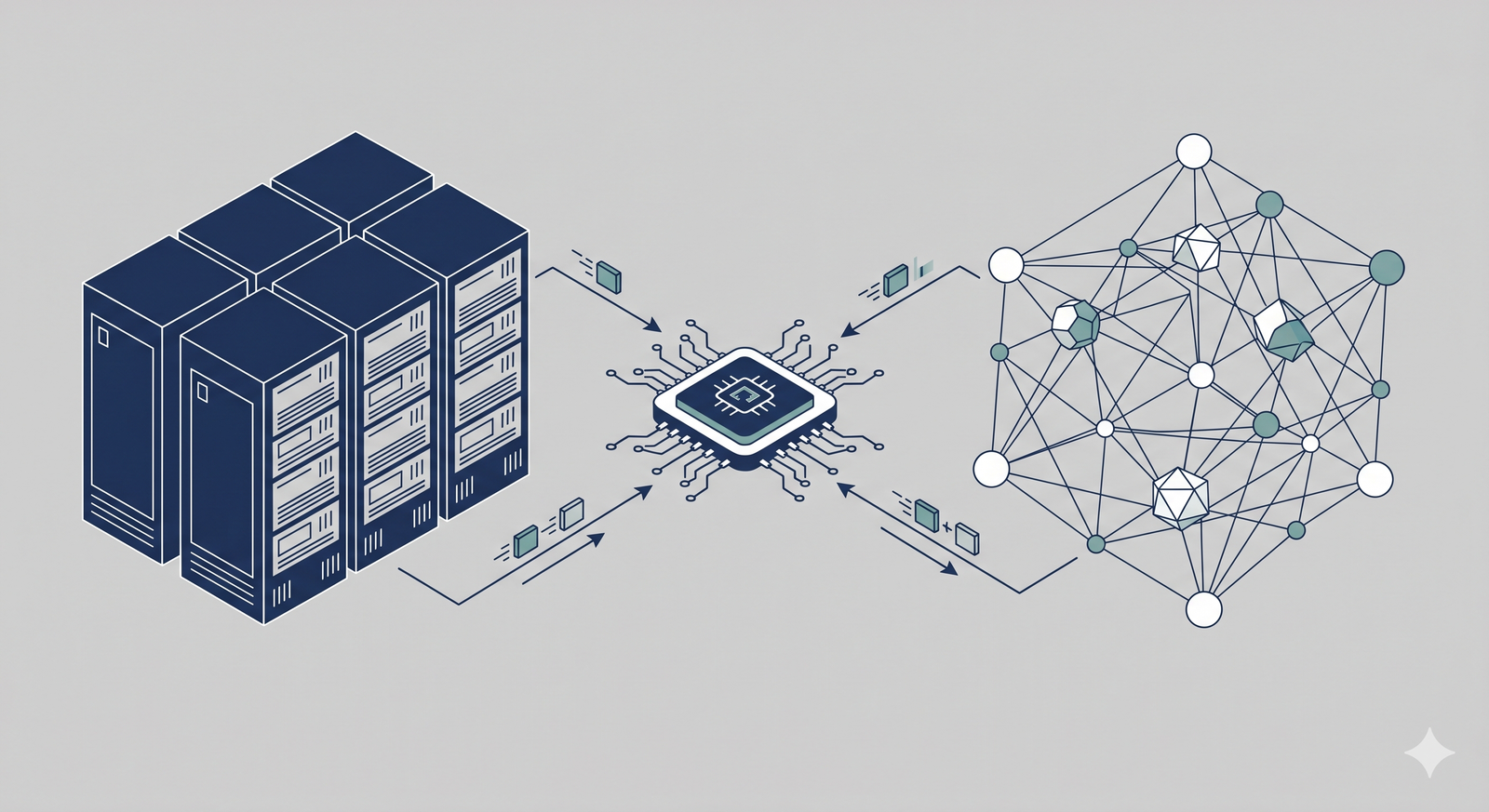
The Core Database Choice for LLMs
Choosing between a vector database and a traditional database depends entirely on your data structure and retrieval goal. Use traditional databases for exact keyword matches, structured metadata, and transactional records. Use vector databases when your Large Language Model (LLM) needs to understand the semantic meaning of unstructured data to perform similarity searches. In most enterprise production environments, you will actually need a hybrid architecture that utilizes both.
The Architectural Divide: How They Store Data
To understand which database to choose, you must understand how they store and index information. Traditional databases and vector databases are built for fundamentally different computational tasks.
Traditional relational databases like PostgreSQL or MySQL organize data into strict rows and columns. They use indexing algorithms like B-Trees to perform exact-match lookups. If you search for the word “contract,” the database looks for that exact string. If the document uses the word “agreement” instead, the traditional database will return zero results.
Vector databases like Pinecone, Milvus, or Weaviate handle data entirely differently. They do not store raw text as their primary searchable index. Instead, they store high-dimensional arrays of numbers called embeddings. When you pass text, audio, or images through an embedding model, it converts the semantic meaning of that data into a mathematical coordinate (a vector).
When you query a vector database, it does not look for exact strings. It uses algorithms like Hierarchical Navigable Small World (HNSW) to calculate the spatial distance between the user’s query vector and the stored document vectors. If “contract” and “agreement” have similar meanings, their vectors will be located close to each other in the vector space, allowing the database to return highly relevant results regardless of the exact phrasing.
When to Use Traditional Databases in AI
There is a misconception that building an AI application requires throwing out your SQL infrastructure. This is false. Traditional databases remain the backbone of most LLM applications for several critical tasks.
You should use a traditional database to store chat histories. When a user interacts with a conversational AI, the LLM needs a fast, chronological record of the conversation. A NoSQL document database like MongoDB or a key-value store like Redis is perfectly suited for rapidly reading and writing JSON-formatted chat logs.
You also need traditional databases for metadata filtering and user authorization. If an enterprise user queries an AI about internal company financials, the system must first verify if that specific user has the security clearance to access those documents. Relational databases execute these strict, boolean-logic queries (True/False, Yes/No) much more efficiently than vector databases.
When Vector Databases Are Mandatory
Vector databases become strictly necessary when you are building a Retrieval-Augmented Generation (RAG) pipeline to query large volumes of unstructured data.
If your goal is to allow an LLM to “read” thousands of PDFs, knowledge base articles, or customer support transcripts to answer a nuanced question, traditional keyword search will fail. Users rarely type the exact vocabulary found in technical manuals. A vector database bridges this gap by retrieving information based on context and intent.
Vector databases are also essential for multimodal AI applications. If you are building a system where a user can upload a picture of a broken machine part and ask the LLM for a replacement manual, you must use a vector database. Embedding models like CLIP can map both images and text into the same vector space, allowing the database to find a text manual that matches the visual features of the uploaded image.
Step-by-Step Logic for Choosing Your Database
If you are architecting a new LLM application, follow this systematic process to determine your infrastructure needs.
Step 1: Audit your data type. Look at the primary data your LLM will consume. If it is highly structured, like financial ledgers or inventory counts, default to SQL. If it is unstructured text, audio, or imagery, you need a vector solution.
Step 2: Define your retrieval goal. Determine how users will interact with the system. If they are looking up specific order IDs or customer profiles, use traditional indexing. If they are asking open-ended, natural language questions, implement vector search.
Step 3: Evaluate your existing infrastructure. Before buying a dedicated vector database, look at your current stack. According to industry surveys, a massive percentage of engineering teams are now using Postgres for AI. By enabling the pgvector extension, you can store vector embeddings directly inside your existing PostgreSQL database, allowing you to perform SQL metadata filtering and vector similarity search in a single query.
Database Comparison Summary
| Database Type | Primary Data Structure | Best Search Method | Ideal LLM Use Case | Example Technologies |
| Relational (SQL) | Rows and Columns | Exact Match (B-Tree) | Metadata, Permissions, User profiles | PostgreSQL, MySQL |
| Document (NoSQL) | JSON Documents | Keyword / Text Search | Chat history, Prompt templates | MongoDB, DynamoDB |
| Dedicated Vector | High-Dimensional Arrays | Semantic Similarity (HNSW) | RAG, Unstructured data, Multimodal | Pinecone, Milvus, Qdrant |
| Hybrid SQL/Vector | Rows + Vector Columns | Exact + Semantic Match | Enterprise RAG with strict filtering | PostgreSQL (pgvector) |
Enterprise Case Study: Hybrid Architecture in Action
A recent project involving a global e-commerce brand highlights why relying on a single database type is often a mistake. The company wanted to build a customer-facing LLM chatbot that could answer product questions and process returns.
Initially, they dumped all product descriptions, return policies, and user purchase histories into a standalone vector database. The system failed in testing. While it was great at answering open-ended questions like “Which running shoe is best for wide feet?”, it hallucinated wildly when asked “What is the status of my order #99821?”. Vector databases are probabilistic; they return the “closest” mathematical match, which is disastrous for exact order tracking.
The engineering team restructured the architecture into a hybrid model. They migrated the user profiles, inventory numbers, and order tracking back to a strict PostgreSQL database. They kept the unstructured product descriptions and return policy documents in a dedicated vector database.
When a user asked a question, a lightweight routing LLM classified the intent. If the intent was transactional (order status), it queried Postgres using standard SQL. If the intent was informational (product advice), it queried the vector database. This hybrid approach reduced data retrieval latency to under 100 milliseconds and completely eliminated transactional hallucinations.
3 Actionable Steps to Optimize Your LLM Database Strategy
- Start with PostgreSQL and pgvector. If you are building a Minimum Viable Product (MVP), do not introduce the operational complexity of a standalone vector database yet. Install the pgvector extension on your existing Postgres instance to handle both structured data and embeddings until you hit scale limitations.
- Separate your chat memory from your knowledge base. Never store conversational history in your vector database. Spin up a fast, cheap Redis or MongoDB instance specifically to feed the LLM its short-term conversational context.
- Implement hybrid search for unstructured text. Even when using a vector database, pure semantic search can sometimes miss obvious keyword matches (like specific acronyms). Configure your search pipeline to use a combination of dense vector embeddings and traditional sparse keyword search (like BM25) to maximize retrieval accuracy.
Need Help Scaling Your AI Infrastructure?
Designing the right data architecture is the most critical factor in preventing LLM hallucinations and managing cloud costs. If you need custom help implementing optimized database routing, setting up scalable RAG pipelines, or deploying enterprise-grade vector search, our AI & Data Science agency can assist. Reach out to us at https://tensour.com/contact to discuss your specific infrastructure needs.
Leave a Reply