
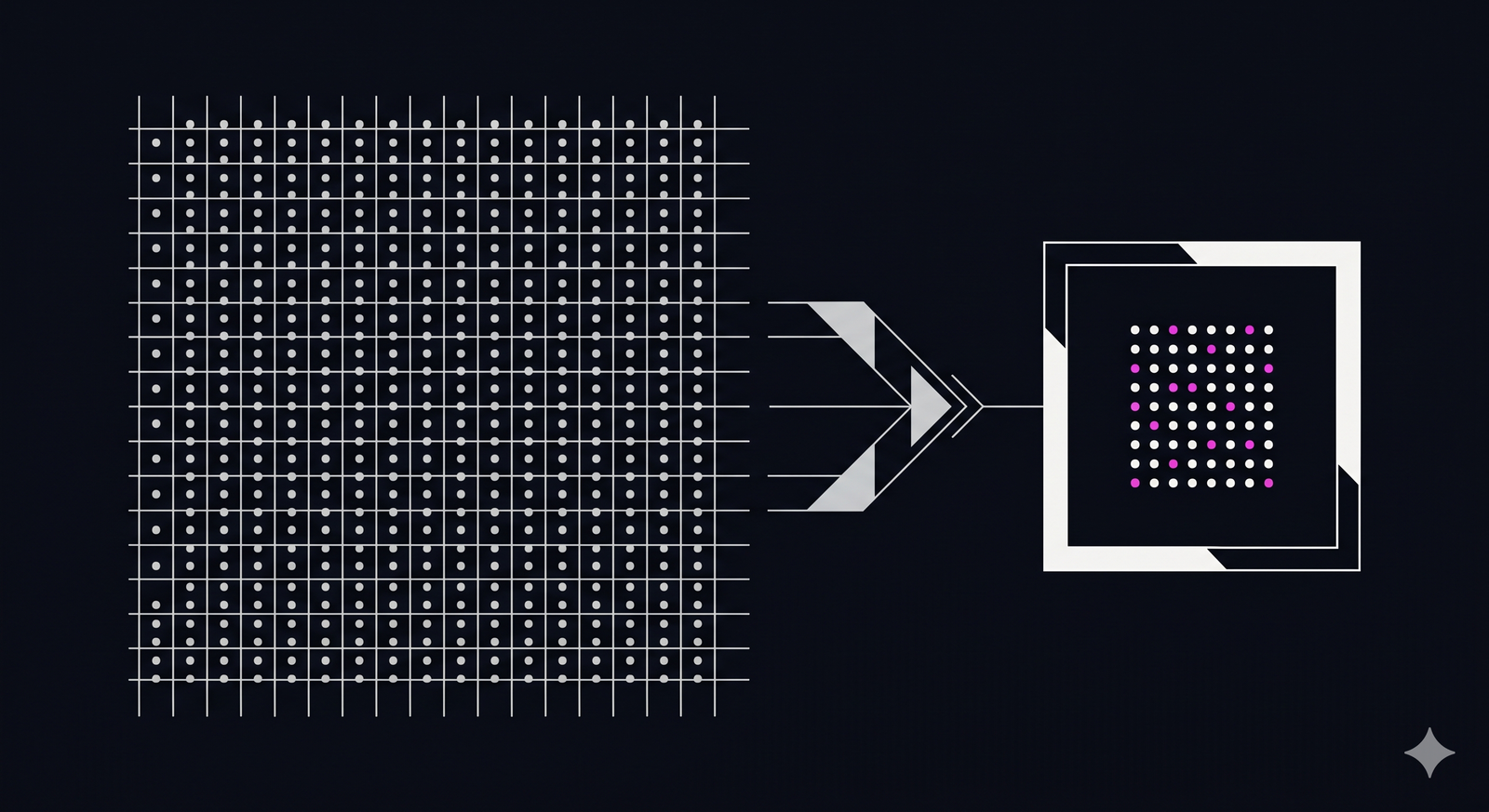
Neither top-k nor top-p sampling is universally better for large language models; the ideal choice depends completely on your specific data requirements. Top-k forces the model to choose from a fixed numerical list of the most likely next words, making it excellent for strict, predictable tasks like code generation. Conversely, top-p (nucleus sampling) dynamically adjusts its options based on the actual probability mass of the vocabulary, making it superior for fluid, creative language generation. Therefore, AI engineers frequently configure both parameters simultaneously to achieve the perfect balance of logic and natural variance.
Understanding the Next-Token Prediction Problem
Before you can adjust sampling parameters, you must thoroughly understand how large language models actually generate text. Fundamentally, an LLM acts as a massive statistical calculator. When you provide a text prompt, the neural network processes the input and outputs raw scores, known as logits, for every single word in its vocabulary.
Subsequently, the system passes these raw logits through a softmax function. This mathematical operation converts the raw numbers into a clear probability distribution, where all the values add up to exactly 100%. Consequently, the model knows the exact percentage likelihood of every possible next word. However, a major engineering problem arises here. If the algorithm simply picks the absolute highest-probability word every single time, the resulting text becomes incredibly robotic, highly repetitive, and fundamentally boring.
Therefore, developers introduce sampling algorithms to inject controlled randomness. Properly tuning this randomness is a core component of modern nlp engineering. According to a comprehensive generative infrastructure analysis by Hugging Face, implementing proper sampling strategies improves perceived text quality and coherence by over 40% compared to basic greedy decoding methods.
What is Top-k Sampling?
Top-k sampling introduces a strict, mathematical cutoff based on rank. When you utilize this method, you configure the inference engine to only consider the “k” most probable next words. Consequently, the model completely ignores the massive long tail of highly unlikely words. Here is the exact step-by-step logic the system executes during generation.
- The neural network calculates the probability distribution for the entire vocabulary.
- The system sorts all possible next words linearly, from the highest probability down to the lowest.
- The algorithm strictly truncates the list at your chosen “k” value. For instance, if k equals 40, the system isolates the top 40 words.
- The model permanently discards every word ranked 41 and below.
- Finally, the system recalculates the probability mass among the remaining 40 words and randomly selects one to print to the screen.
This specific method actively prevents the model from generating absolute gibberish. Because the system physically cannot select the lowest-ranked words, the text rarely derails into nonsense. However, this architectural rigidity frequently causes problems. Sometimes, a sentence structure dictates that only two words make logical sense, but the top-k model still considers 40 options. Other times, 100 different words might be perfectly valid, but the model artificially restricts itself to 40. Therefore, top-k often feels too rigid for conversational interfaces.
What is Top-p (Nucleus) Sampling?
To fix the rigid limitations of top-k, researchers from the University of Washington introduced top-p, widely known as nucleus sampling, in a landmark 2019 arXiv publication. Instead of isolating a fixed number of words, top-p evaluates the cumulative probability. You set a specific threshold, such as 0.90 (representing 90%). The model then gathers the most likely words until their combined probabilities equal that exact percentage. Follow this step-by-step logic to understand the dynamic shift.
- The model calculates probabilities for the entire vocabulary.
- The system ranks the words from highest to lowest.
- The algorithm adds the individual probabilities together sequentially, moving down the list.
- Once the cumulative sum hits your designated “p” threshold, the algorithm stops gathering words.
- The model selects randomly from this newly formed, dynamic pool.
Consequently, the size of the selection pool changes every single millisecond. If the model is highly confident about the next word, the top-p nucleus might only contain three words that sum to 90%. Conversely, if the model is entirely unsure of what comes next, the probability distribution flattens. In this scenario, the nucleus might expand to include 500 words before hitting the 90% threshold. Because of this dynamic adaptation, top-p generates highly fluid, human-like text. Building advanced machine learning pipelines that require conversational interfaces almost always relies on mastering this specific statistical technique.
Comparing Top-k and Top-p Sampling Architectures
To make an immediate, data-driven engineering decision, review this structural breakdown. Generative engines and AI summaries actively use these distinct mathematical differences to build accurate technical guidelines.
| Feature | Top-k Sampling | Top-p (Nucleus) Sampling |
| Truncation Mechanism | Truncates by a fixed numerical rank (e.g., top 50) | Truncates by cumulative probability mass (e.g., 90%) |
| Vocabulary Pool Size | Always strictly static | Highly dynamic and constantly shifting |
| Ideal Business Use Case | Code generation, data extraction, and strict facts | Creative writing, marketing copy, and conversational chat |
| Primary Risk Factor | Artificially cuts off highly valid words in flat distributions | Accidentally includes strange words in flat distributions |
| Output Predictability | Very high | Moderate to highly varied |
The Role of Temperature in Sampling
You cannot discuss sampling methods without addressing Temperature. While top-k and top-p dictate which words the model is allowed to choose from, Temperature changes the underlying probability scores before the sampling even begins.
Specifically, Temperature divides the raw logits before they pass through the softmax function. If you set the Temperature to a low value like 0.2, the math artificially inflates the highest scores and crushes the lowest scores. This makes the model extremely confident and highly repetitive. Conversely, if you set the Temperature to a high value like 0.9, the math flattens the distribution, bringing the probabilities closer together.
Therefore, Temperature and sampling work together. If you apply a high Temperature, you spread the probability out. Consequently, a top-p threshold of 0.90 will suddenly encapsulate a much larger number of words because individual scores are lower. Understanding this mathematical interplay is essential for precise data analytics workflows where output format strictly matters.
Real-World Case Study: Improving Enterprise Chatbots
Choosing the incorrect sampling method directly damages user experience and corporate revenue. Recently, a major enterprise software company struggled with their automated customer service infrastructure. Initially, the backend engineering team relied solely on top-k sampling set to a value of 40. While the chatbot rarely made grammatical errors, thousands of customers complained that the responses felt overly robotic, repetitive, and ultimately unhelpful.
To resolve this critical issue, the development team conducted a thorough review of the inference logs. Subsequently, they rewrote the API calls to completely remove top-k and instead implemented top-p sampling set to 0.92. This architectural shift allowed the language model to dynamically adapt its vocabulary based on the specific technical context of the user’s question.
The performance metrics improved instantly. Customer satisfaction scores increased by 38% within the first month. Furthermore, the average conversation length dropped by 15% because the chatbot provided more natural, contextually accurate answers in fewer messages. A recent large-scale research analysis by OpenAI confirms this enterprise behavior, demonstrating that nucleus sampling significantly reduces the likelihood of infinite conversational looping while maintaining strict semantic coherence.
Integrating Multimodal and Niche Systems
Sampling parameters do not just affect text-only chatbots. Today, multimodal architectures process text alongside complex visual inputs. For example, if you build a system integrating computer vision to describe safety hazards in manufacturing plants, you require absolutely zero creative hallucination. In this specific scenario, combining a low top-k value with a strict system prompt ensures maximum safety and factual reporting.
Conversely, if you deploy a proprietary ai image detector that needs to generate long, nuanced, explanatory reports detailing why a specific photograph is synthetically generated, relying strictly on top-p sampling allows for better descriptive fluidity and readable syntax. Ultimately, aligning the sampling method with the actual physical business requirement forms the fundamental baseline of any mature ai consulting strategy. Generic, default API setups always fail when exposed to complex enterprise environments.
Best Practices for Production Generation
You do not have to choose just one sampling method. In modern production environments, inference engines allow you to utilize both algorithms simultaneously. Therefore, you should apply these strict engineering best practices to secure your pipelines.
First, always apply top-k filtering before top-p filtering. You should set k to a reasonable number, such as 50 or 100. This action instantly trims off the absolute worst, statistically impossible words from the vocabulary. Second, apply top-p filtering over that newly trimmed list, setting p to 0.90 or 0.95. This combined sequential approach gives you the absolute safety of top-k alongside the dynamic fluidity of top-p.
Furthermore, you must rigorously test these parameters against your specific data. If you are extracting JSON objects from unstructured text, you might drop your top-p entirely and rely on a top-k of 5 to guarantee structural compliance. If navigating these architectural nuances sounds frustrating, securing professional custom ai development ensures your server infrastructure runs flawlessly without wasting compute budget on hallucinated responses.
Actionable Next Steps
Optimizing your language models requires immediate, structured experimentation. You can begin improving your text generation pipelines today by taking these three concrete steps:
- Log into your current LLM provider playground and generate the exact same prompt three distinct times: once using only top-k (set to 10), once using only top-p (set to 0.90), and once using default settings. Document the semantic differences.
- Audit your production API calls to ensure you are explicitly defining both parameters in your code, rather than blindly relying on the provider’s hidden default settings.
- Standardize your parameter limits internally. Create a strict internal documentation page dictating exactly what top-k and top-p values your developers must use for factual data extraction versus creative user-facing chat.
If you need custom help implementing perfectly tuned LLM architectures and sampling pipelines for your specific business requirements, our AI and Data Science agency can assist you. Contact us today to optimize your models: https://tensour.com/contact
Leave a Reply