
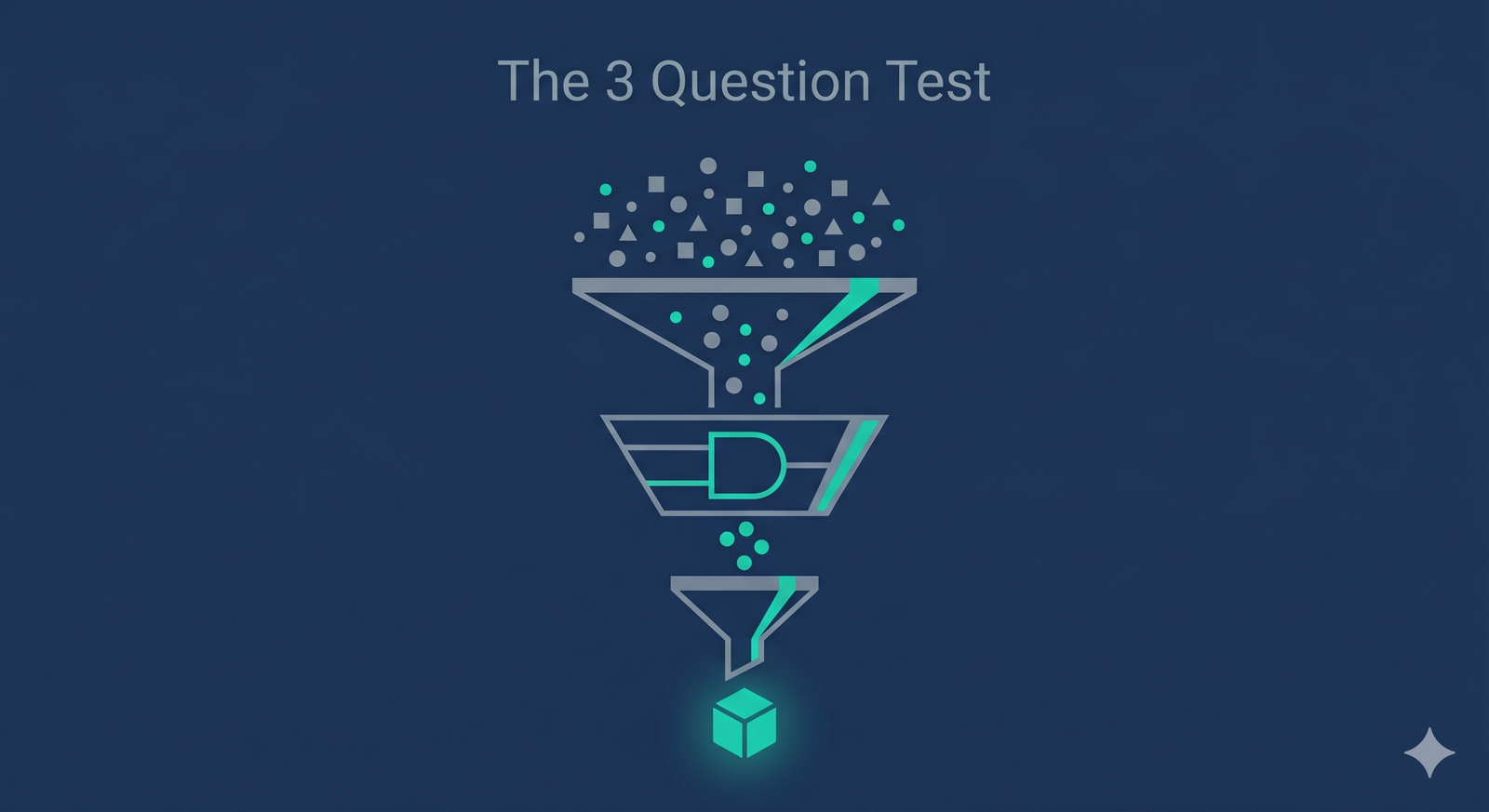
You choose high-impact AI agent use cases by applying a strict three-question test: Is the workflow highly repetitive, is the desired output strictly deterministic, and is the financial cost of a system failure acceptable? If a proposed workflow fails any of these three criteria, deploying an autonomous agent will likely result in stalled pilots and wasted budget. The financial value of an AI agent is generated entirely by successfully executing constrained, high-volume tasks without human intervention, which drastically lowers your operational overhead.
AI agents are software systems capable of reasoning through steps and executing actions using external tools. Unlike standard generative models that merely output text, agents can read a database, make a decision based on logic gates, and trigger an API payload to update a system. However, this autonomy is exactly why so many enterprise deployments fail. This guide details the exact filtering mechanism necessary to separate realistic, profitable AI use cases from expensive science experiments.
The Statistical Reality of Enterprise AI Agents
Many organizations deploy agentic AI because they want to appear innovative to stakeholders, not because they have a specific mathematical problem to solve. This approach leads to severe financial waste and abandoned infrastructure.
According to a 2025 industry report detailed by McKinsey & Company, while 88 percent of companies now use artificial intelligence regularly, only 21 percent ever reach production scale with measurable returns. The vast majority remain trapped in pilot purgatory. Furthermore, the failure rate for autonomous systems is alarmingly high. Research published by Gartner projects that 40 percent of all agentic AI projects will be canceled by 2027 specifically due to escalating costs, unclear business value, and inadequate risk controls.
Conversely, when companies apply strict selection criteria, the returns are massive. Data compiled by Google Cloud on the ROI of AI indicates that early adopters who correctly implement agentic systems project an average ROI of 171 percent. To join that profitable minority, engineering and business teams must stop treating AI as a universal solution. You must run every proposed idea through the following 3-Question Test before writing a single line of code or provisioning a server.
Question 1: Is the Task Highly Repetitive and Data-Dense?
The first test filters out tasks that do not happen frequently enough to justify the engineering cost of building and maintaining an agent.
Artificial intelligence provides zero commercial value for one-off, bespoke problems. The capital expenditure required to build, test, and deploy a secure agent architecture is significant. To achieve a positive return on investment, the agent must execute a task thousands of times. You should look for workflows where human employees are acting as manual data routers—copying information from a supplier email, cross-referencing it in a CRM, and pasting it into an invoice management system.
If a task requires an employee to spend four hours a day parsing unstructured PDFs into a structured database, it is a perfect candidate. If a task requires strategic thinking once a month, such as deciding which new geographical market to enter, an agent will fail. High volume dilutes the initial build cost.
Step 1: Audit your department’s weekly human hours using time-tracking software.
Step 2: Isolate tasks that consume more than 20 percent of a team’s collective time but require absolutely no creative thought.
Step 3: Verify that the data required to complete the task is digitally accessible via standard APIs or existing data analytics platforms. If the data is locked in physical file cabinets, you cannot use an agent.
Question 2: Is the Output Deterministic or Highly Constrained?
The second test filters out tasks that rely on human subjectivity, nuance, or fluid business rules.
Large language models are inherently probabilistic; they guess the next most likely word based on vector embeddings and historical training data. Business operations, however, require deterministic outcomes—meaning an invoice total must match a purchase order exactly, every single time. When you give an agent too much freedom or ask it to interpret vague instructions, it will hallucinate or execute the wrong action.
The best AI agent use cases are heavily constrained by code. For example, an agent tasked with reading a logistics manifest and updating a shipping database if the delivery date is within a 48-hour window is highly constrained. The rules are absolute. Conversely, an agent tasked with writing a persuasive, empathetic email to a highly agitated enterprise client to prevent churn is unconstrained. The parameters of success are entirely subjective and emotional.
If the success of a workflow depends on an employee’s gut feeling, empathy, or undocumented industry experience, do not attempt to automate it. You must utilize strict machine learning guardrails and clear logic gates to ensure the agent only operates within mathematical certainties.
Question 3: Is the Cost of Failure Acceptable?
The third and most critical test filters out tasks where an AI mistake would cause catastrophic financial, legal, or reputational damage.
Every AI system, regardless of how well it is engineered, will eventually make a mistake. You must ask yourself: What happens when the agent fails? If an internal IT support agent hallucinates and tells an employee to reboot their laptop to fix a localized printer issue, the cost of failure is five minutes of mild annoyance. The risk is completely acceptable.
If an autonomous trading agent misreads a news headline, bypasses its risk parameters, and executes a ten-million-dollar sell order, the cost of failure is catastrophic. If a healthcare routing agent misclassifies patient triage data, the cost of failure is physical human harm.
According to security benchmarks highlighted by OWASP in their Agentic AI framework, missing guardrails, prompt injection vulnerabilities, and unmonitored agent sprawl are the leading causes of autonomous system failures. If a process cannot tolerate a 1 to 3 percent error rate without destroying the business, you must enforce a strict human-in-the-loop architecture, or abandon the use case entirely.
Applying the Test: A Real-World Comparison
To demonstrate how to choose high-impact AI agent use cases, let us evaluate two common enterprise proposals using the framework.
Scenario A: Automating Tier-1 IT Password Resets
- Is it repetitive? Yes. IT service desks handle thousands of these low-level requests monthly.
- Is it deterministic? Yes. The steps to verify an employee ID and trigger a secure reset link are absolute.
- Is the failure cost acceptable? Yes. If the agent fails to understand the request, the ticket simply escalates to a human technician.Verdict: Pass. This is an ideal, high-ROI use case for natural language processing and agentic automation.
Scenario B: Automating Executive Financial Forecasting
- Is it repetitive? No. Forecasts are typically done quarterly and require analyzing different strategic variables each time.
- Is it deterministic? No. Forecasting requires subjective interpretation of market shifts, consumer trends, and competitor behavior.
- Is the failure cost acceptable? No. A hallucinated revenue projection will result in misallocated company capital, disrupted supply chains, and potential investor lawsuits.Verdict: Fail. This should remain a human-driven process, potentially augmented by standard data dashboards, but never handed to an autonomous agent.
AI Agent Use Case Evaluation Summary
Use this matrix during your internal planning meetings to immediately disqualify bad AI projects before they consume your engineering budget.
| Evaluation Criteria | High-Impact Agent Use Case | High-Risk/Failed Agent Use Case |
| Task Frequency | Thousands of executions per week | Sporadic, monthly, or ad-hoc tasks |
| Output Requirement | Rule-based, strict pass/fail parameters | Subjective, creative, or empathetic |
| Data Environment | Structured APIs and clean databases | Unstructured, offline, or siloed data |
| Failure Consequence | Minor delay, falls back to human queue | Legal liability, massive financial loss |
| Primary Objective | Lowering operational cost per action | Attempting to replace strategic leadership |
3 Actionable Next Steps
Do not build an agent just to see what the technology can do. Use this framework to protect your engineering resources and focus entirely on measurable profit.
- Interview your ground-level operations team to identify the top three most repetitive, high-volume data entry tasks they perform daily. Do not ask executives; ask the people executing the work.
- Run those three tasks through the 3-Question Test. Immediately discard any task that requires subjective human judgment or carries high regulatory compliance risk.
- For the single task that passes the test, map out the exact API endpoints and software tools the agent will need access to before you authorize any custom AI development.
Conclusion
Choosing the right AI agent use case is an exercise in operational discipline. By rigorously applying the 3-Question Test—focusing exclusively on high repetition, strict deterministic constraints, and low failure risk—you can deploy autonomous systems that escape pilot purgatory and deliver genuine financial returns.
If you have identified a viable workflow and need experienced engineers to build it securely, our AI consulting and strategy team can help. Tensour specializes in designing, deploying, and governing enterprise-grade agentic systems. Visit https://tensour.com/contact to stop experimenting and start automating.
Leave a Reply