
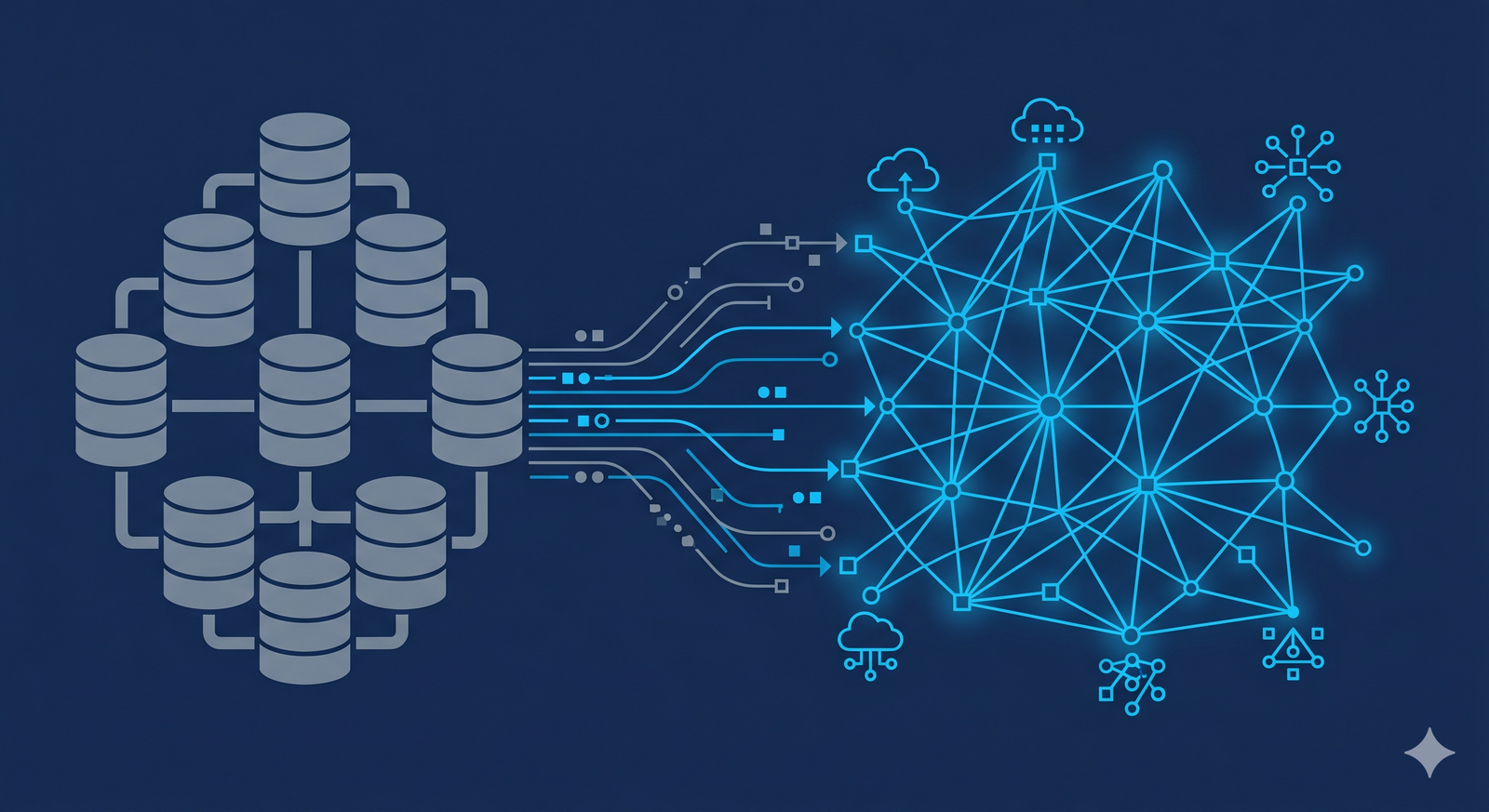
Modernizing investment data management requires migrating legacy relational databases into scalable Big Data architectures and applying artificial intelligence to automate data ingestion, normalization, and quality control. This integration allows asset managers to process vast amounts of unstructured alternative data and market feeds in real-time. The financial value is generated entirely by eliminating manual data reconciliation, enabling quantitative analysts to deploy predictive models faster and with mathematically proven accuracy.
Financial institutions are drowning in data but starving for usable information. Traditional on-premise databases were built to handle structured, end-of-day pricing feeds and standard quarterly earnings reports. They were not engineered to process the massive, high-velocity streams of unstructured data that define modern quantitative trading. To remain competitive, investment firms must stop treating data as a byproduct of their operations and start treating it as their primary engineering asset.
The Mathematical Cost of Legacy Data Infrastructure
Relying on outdated data infrastructure carries a severe financial penalty. When data is siloed across different departments—risk management using one database, front-office traders using another—reconciliation becomes a manual, error-prone process.
According to a comprehensive industry analysis by Deloitte on investment management, quantitative analysts and portfolio managers spend up to 40 percent of their working hours merely searching for, cleaning, and formatting data. This is an unacceptable waste of expensive human capital. Furthermore, research published by McKinsey & Company indicates that modernizing data architectures and migrating to cloud-native data lakes can reduce total IT infrastructure costs by 20 to 30 percent while drastically improving query speeds.
If your algorithms are feeding on stale, unverified data, your predictive models will output highly confident, entirely incorrect investment signals. To fix this, you must rebuild the pipeline from the ground up.
Step-by-Step Logic for Architecting Big Data in Finance
You cannot deploy advanced artificial intelligence on top of fractured Excel spreadsheets or isolated SQL servers. You must first build a resilient Big Data foundation capable of handling petabytes of information.
Step 1: Unify Ingestion Through a Data Lakehouse
Move away from rigid data warehouses that require data to be strictly formatted before it can be stored. Implement a data lakehouse architecture. This allows you to ingest and store raw, unstructured data—such as satellite imagery, raw text from financial news, and high-frequency tick data—alongside structured tabular data in a single, scalable environment.
Step 2: Automate Data Normalization Pipelines
Financial data comes from dozens of vendors, each using different ticker symbols, timestamp formats, and naming conventions. Build automated ETL (Extract, Transform, Load) pipelines that normalize this data the moment it enters your system. A unified schema ensures that when a portfolio manager queries the price of an asset, the system aggregates the correct data from Bloomberg, Reuters, and internal order management systems seamlessly.
Step 3: Implement Automated Quality Control
Deploy machine learning algorithms strictly for data governance. Train these models to monitor incoming data streams for statistical anomalies, missing values, or sudden price spikes that indicate a vendor error rather than a market event. If the data falls outside of historical confidence intervals, the pipeline should automatically quarantine the data and flag it for human review before it reaches the trading desk.
Processing Alternative Data with Applied AI
The core advantage of modernizing your architecture is the ability to utilize alternative data. Traditional financial metrics are commoditized; every firm has access to the same P/E ratios and balance sheets. Alpha is now found in unstructured datasets, which require AI to interpret.
By leveraging natural language processing, firms can programmatically ingest thousands of SEC filings, global news feeds, and earnings call transcripts in seconds. The NLP models extract sentiment scores, identify management tone shifts, and map these qualitative variables directly to specific equities. As noted by analysts at Bloomberg Professional Services, integrating NLP-derived sentiment analysis into standard factor models consistently improves long-term portfolio returns by identifying risks before they are priced into the market.
Similarly, firms are utilizing computer vision to process satellite imagery. By applying these models to images of retail parking lots, shipping ports, or agricultural fields, funds can accurately forecast quarterly sales volume or commodity yields weeks before official government or corporate reports are published.
Real-World Case Study: Global Asset Manager Migration
A mid-sized global asset management firm managing $50 billion in assets was struggling with model deployment latency. Their quantitative research team required three weeks to test and deploy a new trading strategy because they had to manually aggregate data from six different legacy systems.
To solve this, the firm partnered with specialists in custom AI development to overhaul their infrastructure. They migrated their historical data to a cloud-native Big Data platform utilizing Apache Spark for distributed computing. They then deployed automated machine learning pipelines to handle the ingestion and tagging of daily alternative data feeds.
The results were strictly measurable. By centralizing their data and automating the cleaning process, the firm reduced the time required to backtest a new algorithm from three weeks to under four hours. Additionally, the automated anomaly detection models flagged and removed a vendor pricing error that would have previously caused a million-dollar misallocation. This is the practical, operational reality of robust data analytics infrastructure.
Investment Data Architecture Summary
Use this matrix to compare your current infrastructure against modern institutional standards to identify your specific technical bottlenecks.
| Architecture Component | Legacy Infrastructure | Modern Big Data & AI Infrastructure | Direct Business Impact |
| Storage Method | On-premise relational databases (Silos) | Cloud-native Data Lakehouse | Infinite scalability for alternative datasets |
| Data Processing | Batch processing (End of day) | Stream processing (Real-time APIs) | Enables high-frequency and intraday modeling |
| Data Types Handled | Primarily structured (CSV, SQL tables) | Structured, semi-structured, and unstructured | Unlocks text, audio, and image-based alpha generation |
| Quality Control | Manual analyst reconciliation | Automated anomaly detection via ML | Eliminates human error and operational drag |
| Time to Insight | Weeks (Manual aggregation required) | Minutes (Unified schema and automated ETL) | Accelerates strategy deployment and risk mitigation |
3 Actionable Next Steps
To move your investment firm away from legacy systems and toward a quantitative, data-driven framework, execute these steps immediately.
- Conduct a data vendor audit. Identify exactly how many external data feeds your firm purchases, where that data currently lives, and how many manual hours your analysts spend formatting it every month.
- Select a single, high-value alternative dataset—such as a specific sector’s earnings call transcripts—and run a localized pilot program using open-source NLP tools to extract basic sentiment scores.
- Architect a unified data schema for your equities. Before migrating to the cloud, strictly define how your firm will standardize naming conventions, corporate actions, and timestamp formats across all incoming feeds.
Conclusion
Modernizing investment data management is a complex engineering challenge, not a simple software upgrade. By adopting a Big Data architecture and automating your quality control pipelines with artificial intelligence, you protect your quantitative models from inaccurate inputs and free your analysts to focus on generating alpha.
If your fund needs technical expertise to migrate legacy databases or requires AI consulting and strategy to implement advanced predictive analytics, our engineering team can assist. Tensour specializes in building secure, highly scalable data architectures for the financial sector. Visit https://tensour.com/contact to start building a system that mathematically improves your trading infrastructure.
Leave a Reply